


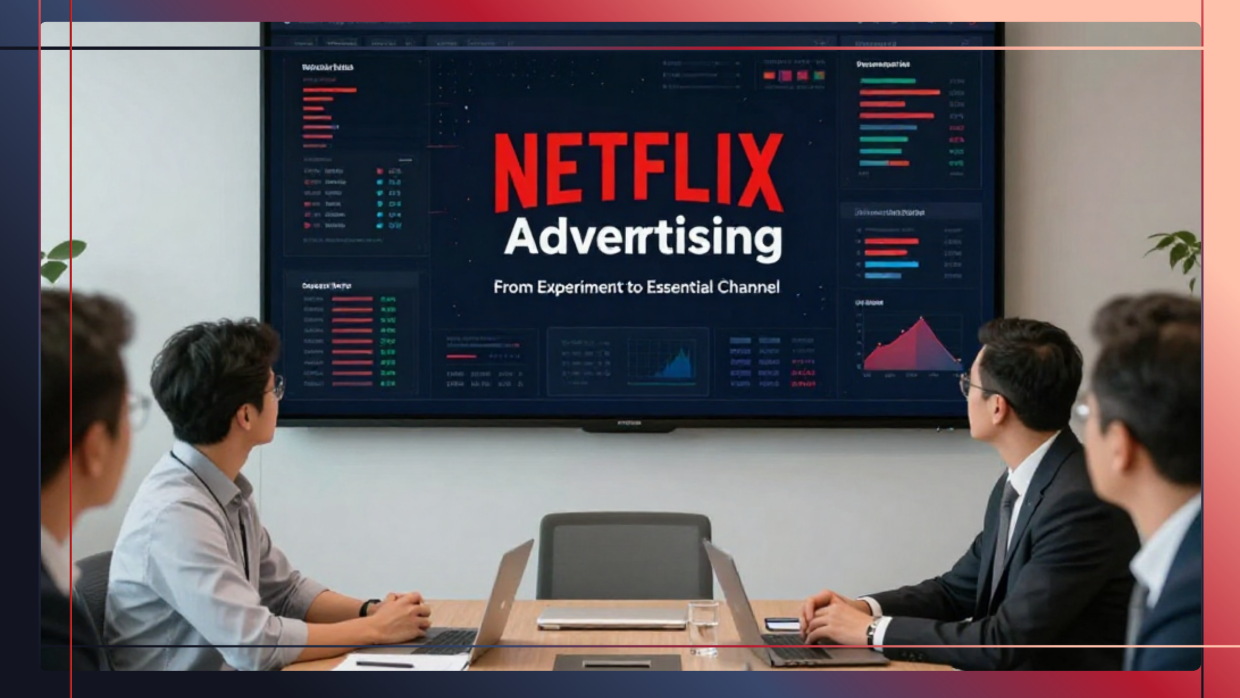

For years, Netflix was the one platform advertisers couldn’t touch.
While audiences steadily shifted away from linear TV and into streaming, one of the largest pools of attention remained completely closed to brands. That changed in late 2022 with the launch of Netflix’s ad-supported tier—but at the time, it still felt like an experiment.
That phase is over.
With millions of monthly active users on ad-supported plans and a growing share of new sign-ups choosing that option, Netflix has quietly become one of the most important emerging channels in premium video. More importantly, it’s evolving in a way that’s distinct from both traditional TV and other streaming platforms.
For agencies and marketers running video or CTV campaigns, the question is no longer if Netflix should be considered—but how to approach it properly.
Why Netflix Advertising Matters Now
The scale alone makes Netflix impossible to ignore.
The ad-supported tier has moved well beyond niche status and is quickly becoming a default entry point for new subscribers. That shift signals a broader change in consumer behaviour: audiences are increasingly willing to trade ads for lower subscription costs, even on premium platforms.
At the same time, Netflix solves a problem that’s been getting harder every year—reaching younger, cord-cutting audiences.
Traditional TV struggles here. Social platforms offer reach but often lack attention. Netflix sits in a different position altogether:
- Viewers actively choose what to watch
- Sessions are longer and more intentional
- Content is perceived as premium
- Ads appear within a focused viewing experience
This creates a rare combination: high attention in a high-quality environment.
You’re not interrupting a scroll—you’re joining an experience the viewer has already committed to.
A Different Kind of CTV Inventory
It’s easy to categorise Netflix as just another connected TV placement. Technically, that’s correct. Practically, it’s misleading.
Most CTV environments still carry behaviours inherited from traditional television—background viewing, channel switching, or multitasking. Netflix usage looks different.
Viewers typically:
- Select specific content rather than browse passively
- Watch for extended periods
- Engage more deeply with what they’re watching
That context has direct implications for advertising.
Creative expectations are higher
Ads that feel out of place—recycled social videos or generic TV spots—stand out for the wrong reasons. In contrast, creative that matches the tone and quality of the surrounding content is more likely to resonate.
Attention is more valuable
Because viewers are more engaged, each impression carries more weight. This shifts the focus from sheer reach to quality of exposure.
The Shift to Programmatic Access
One of the biggest barriers to Netflix advertising early on was accessibility.
Initial campaigns required high minimum spends and direct relationships, limiting participation to large brands. That’s changed significantly with the rollout of Netflix’s in-house advertising platform and integrations with major programmatic partners.
Today, advertisers can access Netflix inventory through familiar demand-side platforms, including:
- Amazon DSP
- Google Display & Video 360
- The Trade Desk
- Yahoo DSP
This aligns with a broader industry trend—programmatic now dominates connected TV buying.
The impact is straightforward:
- Lower barriers to entry
- Easier integration into existing media plans
- Greater flexibility in testing and optimisation
For agencies, it means Netflix can now sit alongside other video channels rather than requiring a separate, specialised approach.
Targeting Is More Sophisticated Than It Looks
A common misconception is that Netflix audiences are too broad to target effectively.
In reality, the platform’s first-party data is one of its biggest strengths.
Because Netflix sits at the centre of the viewing experience, it has direct insight into:
- What people watch
- How often they watch
- When and how they engage with content
This allows for more nuanced audience segmentation than simple demographics.
Examples of targeting approaches
- Genre-based audiences (e.g. true crime, documentaries, reality TV)
- Behavioural patterns (frequent viewers vs casual users)
- Engagement levels and viewing intensity
This moves targeting beyond “who the user is” to “what they’re actively interested in”—a meaningful shift for campaign relevance.
What Marketers Often Get Wrong
Despite the opportunity, many early campaigns underperform—not because the platform lacks potential, but because it’s approached incorrectly.
1. Treating Netflix like standard CTV
Repurposing existing video assets without considering context is one of the most common mistakes.
What works on YouTube or traditional TV won’t necessarily translate. Netflix demands creative that feels intentional and aligned with the viewing experience.
2. Underestimating the targeting capability
Assuming broad reach equals poor precision leads to missed opportunities. The platform’s data allows for far more refined audience strategies than many advertisers realise.
3. Waiting for the platform to “mature”
This is a strategic misstep.
Platforms like Netflix don’t reach a fixed, finished state. They evolve. The brands that benefit most are those that build understanding early—testing formats, establishing benchmarks, and refining creative approaches as capabilities expand.
Measurement and What to Expect
Measurement on Netflix is improving, but it’s still developing compared to more mature digital channels.
Advertisers can expect:
- Standard video metrics (impressions, completion rates)
- Increasing integration with third-party measurement tools
- Gradual expansion of attribution and performance insights
The key is to approach Netflix with realistic expectations.
It’s not a direct-response channel in the same way as paid search or social. Its strength lies in:
- Brand awareness
- Consideration
- Incremental reach
Over time, as measurement evolves, its role in performance strategies will likely expand—but today, it sits firmly in the upper to mid funnel.
Where Netflix Fits in a Modern Media Mix
Netflix works best as part of a broader video strategy rather than a standalone channel.
It complements:
- Linear TV (by extending reach to cord-cutters)
- YouTube (by adding a premium, high-attention layer)
- Other CTV platforms (by diversifying inventory quality)
For agencies, the practical implication is clear:
If you’re already investing in video, Netflix should be part of the conversation.
Not because it replaces other channels—but because it fills a gap they can’t fully address.
The Opportunity for Early Movers
There’s a consistent pattern with emerging channels.
Early adopters:
- Build internal knowledge faster
- Establish performance benchmarks
- Develop creative best practices
- Gain more support from platform teams
Late adopters:
- Follow established norms
- Compete in a more crowded environment
- Have less room to experiment
Netflix is currently in that early-to-mid stage where both outcomes are still possible.
Final Takeaway
Netflix advertising is no longer experimental.
It’s a scaled, accessible, and increasingly sophisticated channel that offers something rare in today’s media landscape: engaged audiences in a premium environment.
The real opportunity isn’t just in accessing that inventory—it’s in understanding how to use it properly.
For agencies and marketers, the next step is simple:
- Test early
- Treat it differently from other channels
- Invest in creative that matches the environment
- Build a baseline now, not later
Because as the platform matures, the advantage will belong to those who already know what works.
Related Articles




Why Choose Us?
With decades of experience and a dedicated team, we are committed to delivering high-quality web development services. Our client-centric approach ensures that we understand your needs and provide solutions that exceed your expectations.