



Growing When Resourcing Costs Are So High: Practical Strategies Beyond Hiring Full-Time Staff

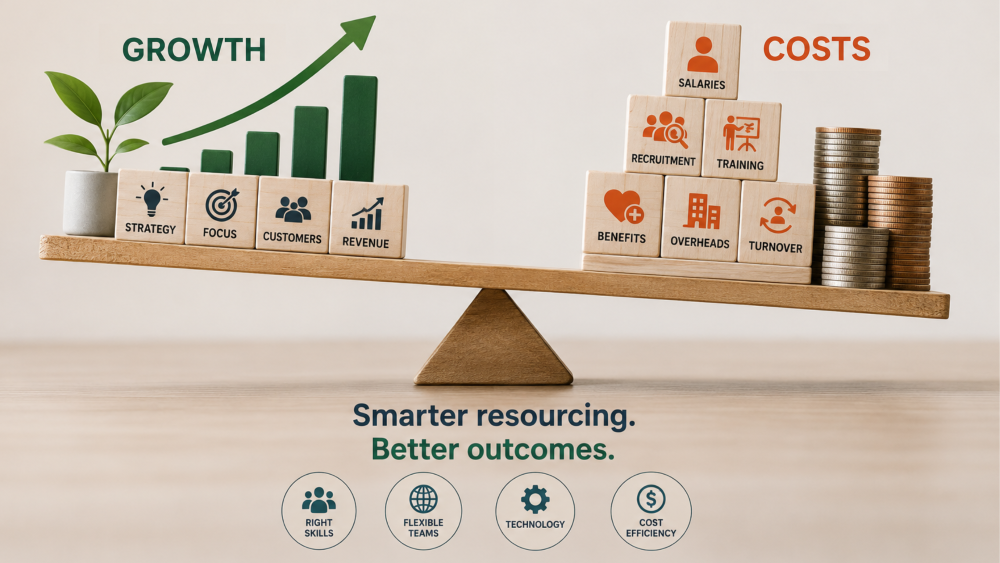
For several Agency Leaders, growth has been seemingly paradoxical over recent years. There is an obvious demand for services, and many opportunities are being created; however, the costs associated with the hiring process continue to increase. As a result, salaries, and employee benefit costs are rising, and because of the current tight labor market, it is becoming increasingly difficult to scale via local, full-time employees.
Sonnet‘s survey of 100 Agency Leaders illustrates this constraint as follows: Four out of Ten Agencies surveyed stated that Human Resource Costs are either Very Significant or Extremely Significant when considering their future expansion plans. In contrast to viewing this as a barrier to growth, many agencies are beginning to redefine the challenge.
Growth does not necessarily require agencies to hire additional full-time employees. The true opportunity exists in agencies’ ability to understand how they can differentially resource their workforce — and at what point to utilize each of those options.
This article will examine four practical resourcing options and explain how a blended approach can create a more sustainable method for growing an agency.
1. Interns: Low-Cost, High-Potential Growth Engines
Interns are commonly undervalued; however, when used correctly, interns can be among the most valuable employees in the long term to an agency.
Why interns perform work:
- Interns are cheaper than experienced employees.
- Interns are highly adaptable especially by students working in digital, creative, and technology fields.
- Interns provide a long-term pipeline for developing talent as many successful interns develop into full-time staff members of the agency.
When to use interns:
- Interns will be most effective when:
- Interns have clearly defined tasks that do not require significant experience (e.g., reporting, research, assisting with basic design).
- The agency has a commitment to training and mentoring interns.
- The agency’s culture allows for employee development and advancement.
- Recommendations for Best Practices.
- Have a formal onboarding process for interns that includes defined expectations and requirements.
- Pair each intern with a member of the agency’s core team who will act as a mentor.
- Do not treat internship programs solely as a means to save money or reduce costs.
Interns may take longer to generate value than other employees, but they can contribute to building an agency’s loyal workforce, bring new ideas and concepts to an organization and add to the future workforce at a relatively lower cost.
2. Local freelancers: flexibility without long-term commitment
The advantages of freelancing:
- Local freelancers give you a flexible option that does not involve a long term contract.
- A number of agencies view freelancers as their first option after recruiting permanently and there is a reason for this.
What Freelance Adds Value To Your Business:
- Time – Access to freelance specialist skills can generally occur quickly.
- Flexibility – Freelance capacity can grow and reduce as needed, with no ongoing overhead costs.
- On-demand Expertise – Niche skill sets can be accessed at the time they are needed.
When Is Freelance The Right Option?
Freelance talent can be best utilized in the following areas:
- Temporary project spikes and short term delivery of projects.
- Individual, one-off, or specialized jobs.
- As a test of new service offerings prior to fully committing to permanent employment.
How to Manage Freelance Talent:
- Clearly define the scope of work, timeline and what needs to be delivered by the freelancer.
- Set clear expectations regarding communication and availability for the freelancer.
- Fairly compensate freelancers – Good freelance talent is in high demand and worth retaining as a resource.
When managed properly, freelancers will begin to feel like an extension of your internal team versus being viewed as a temporary solution.
3. Offshore full-time resources: lower cost, deeper integration
With offshore, full-time staffing, you take a larger leap and you create a major advantage for agencies looking to reduce their labor costs.
Why Off-Shore Works:
- Off-Shore offers lower labor costs but still provides the same level of commitment from an employee.
- You get a full-time employee who learns your tools, your process, your standards, etc.
Over time, you have continuity and a way to develop skills within an employee.
When Does Off-Shore Work Best?
This offshore model will work best if:
- The workflows you have are well-documented and repeatable.
- You need ongoing capacity (not just temporary assistance).
- Your leadership is comfortable with managing a distributed team (in this case, a team based overseas).
Creating Successful Off-Shore Teams
- You should hire through reputable partners that support compliance and the onboarding of employees.
- You should invest in robust communication tools as well as regular communication cadences.
- You should establish clear career paths — because even though they may be working remotely or offshore; employee retention is important regardless of where they are located.
When executed correctly, offshore teams will provide the benefits of a full-time employee — at a much lower labor cost, which is why it is aligned so closely with what many agencies are doing by using partnerships and alternate delivery models to create more predictable and scalable operations.
4. Other agencies and white-label partners: partner, don’t just outsource
Sometimes, the best resource strategy can be NOT HIRING AT ALL, but instead of partnering.
Why Partnerships Work
- Access to Capacity, instantly – No Recruitment Needed
- Capacity with Proven Capability to Plug Directly into Client Work
- Risk Shared – Especially with White-Label Arrangements
Agency Partnership Successes
Agency partnerships are ideal when:
- You Are Scaling Rapidly to Meet Demand
- You Want to Enter New Service Areas
- Your Internal Teams Already Have All They Can Handle
Most Common Models Used in Agency Partnerships
- White-Label Delivery: The Partner Delivers Work Under Your Brand
- Co-Delivery: Proposals and Execution Responsibilities are Shared
- Subcontracting: Targeted Support for Specific Campaigns, Functions, etc.
Success Factors for Effective Agency Partnerships
- Partner Selection Criteria: Communication, Quality Controls, Confidentiality
- Expectations: Confidentiality, Delivery Timelines, Feedback from Clients
Treat Partners Like an Extension of Your Agency, not a Vendor
When Done Strategically, Agency Partnerships Become Growth Enablers Rather Than Short-Term Fixes and Highlight the Importance of Choosing the Right Resource Model At the Right Stage of Agency Growth
Choosing the right model at the right time
Each resourcing option has merit, and many agencies find that a hybrid approach delivers the best results.
| Growth need | Best option |
| Short-term capacity or niche skills | Local freelancers |
| Long-term scalable roles with budget pressure | Offshore full-time |
| Cost-sensitive talent pipeline | Interns |
| Rapid expansion or new service areas | Agency / white-label partners |
Ask yourself:
- Is this role ongoing or ad-hoc?
- Do I need deep integration with the team?
- What is the cost versus value over time?
- How quickly do I need to resource?
Your answers will guide the mix that suits your agency’s goals and rhythm.
Final Takeaway
Resource costs may limit your ability to grow, but they do not have to be an obstacle to future expansion. When you think outside the box of just hiring full-time employees locally and recognize which alternatives will be best in different situations, you can create an adaptable, affordable team that grows as fast as your client base demands.
The key to sustaining your business growth is not about hiring more employees but rather finding a way to resource your company effectively.
If this article has caused you to take a second look at your current method for using resources, please feel free to forward this article to a fellow agency owner who may also be facing similar challenges, or to subscribe to the Sonnet eNewsletter for more ideas, suggestions and insight into building a successful and sustainable agency.
Related Articles


Why Choose Us?
With decades of experience and a dedicated team, we are committed to delivering high-quality web development services. Our client-centric approach ensures that we understand your needs and provide solutions that exceed your expectations.