


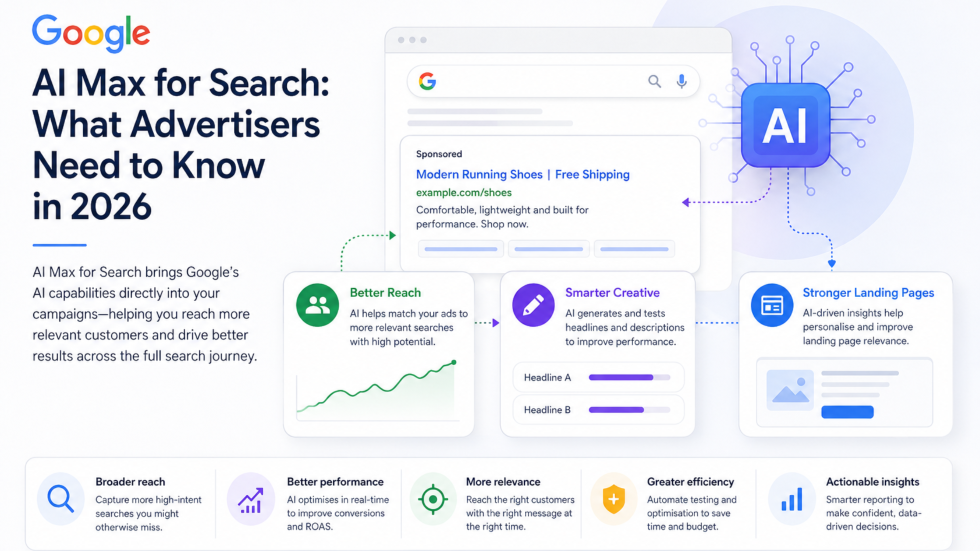

Google has spent years moving advertisers towards greater automation. Smart Bidding, Performance Max, responsive search ads, and automated assets have all shifted campaign management away from manual controls and towards machine learning.
In 2026, that trend continues with AI Max for Search.
For many advertisers, AI Max represents the next step in Google’s vision for search advertising. It uses AI to expand keyword targeting, generate creative assets, identify new search opportunities, and optimise campaign delivery in real time. Google reports that advertisers enabling AI Max typically see around 14% more conversions or conversion value at a similar CPA or ROAS. However, those gains depend heavily on the quality of campaign setup and data feeding the system.
The opportunity is significant, but so is the risk of treating automation as a substitute for strategy.
What Is AI Max for Search?
AI Max is not a new campaign type. Instead, it is a layer of AI-powered targeting and creative enhancements that can be applied to existing Search campaigns. Google describes it as a way to expand campaign reach beyond traditional keyword matching while improving ad relevance through automated optimisation.
Key capabilities include:
- Expanded search term matching using broad match and keywordless technology
- AI-generated headlines and descriptions
- Dynamic landing page selection through URL expansion
- Enhanced reporting and search term insights
- Real-time optimisation based on user intent
Rather than relying solely on the keywords you provide, AI Max analyses your ads, landing pages, historical performance data, and conversion signals to determine where your ads should appear.
This allows campaigns to capture search demand that traditional keyword targeting may never identify. As AI continues to reshape paid search campaigns, advertisers have greater opportunities to uncover valuable search intent that may previously have been missed through manual keyword targeting alone.
The Shift Beyond Traditional Keywords
For years, keyword research sat at the centre of paid search strategy.
Advertisers would identify relevant terms, organise them into tightly themed ad groups, write matching ad copy, and optimise based on performance.
AI Max changes that model.
Instead of focusing purely on exact keyword matches, Google’s AI evaluates the intent behind searches and determines whether your business may be relevant to a wider range of queries. Google refers to this as combining keyword-based targeting with keywordless matching technology.
This creates new opportunities to discover:
- Emerging customer needs
- Long-tail search behaviour
- Previously overlooked search terms
- Additional conversion opportunities
For advertisers looking to scale, this can be extremely valuable.
However, broader reach also means less direct control.
The challenge becomes ensuring that increased visibility translates into qualified customers rather than simply more clicks or leads.
Why Conversion Tracking Matters More Than Ever
AI systems are only as effective as the data they receive.
One of the most common mistakes businesses make is enabling advanced automation without first reviewing their conversion tracking setup.
If Google is optimising towards inaccurate or low-value conversion actions, AI Max will simply generate more of them.
For example:
- Form submissions that never become sales
- Unqualified enquiries
- Spam leads
- Low-intent downloads
- Accidental conversions
From Google’s perspective, a conversion is a conversion unless you tell it otherwise.
This means poor tracking can quickly lead campaigns in the wrong direction.
Before enabling AI Max, advertisers should audit:
- Conversion tracking accuracy
- Offline conversion imports
- CRM integrations
- Lead qualification processes
- Revenue attribution
The more accurately your business defines success, the better AI can optimise towards meaningful outcomes.
Businesses already investing in Google Ads management should view AI Max as an enhancement to strategy rather than a replacement for proper campaign measurement and oversight.
More Leads Doesn’t Always Mean Better Results
One of the most important lessons advertisers need to understand in 2026 is that conversion volume and business performance are not always the same thing.
A campaign may produce more leads after enabling AI Max.
At first glance, that sounds like success.
However, if those leads are less qualified, sales teams may spend more time chasing poor opportunities while revenue remains unchanged or even declines.
This issue is frequently discussed among PPC practitioners testing AI-driven campaign expansion, particularly in lead generation environments where conversion quality can vary significantly.
The better question is not:
“Did conversions increase?”
It’s:
“Did qualified leads and revenue increase?”
Businesses that focus only on top-line conversion numbers often miss what is happening further down the sales funnel.
AI Still Needs Human Oversight
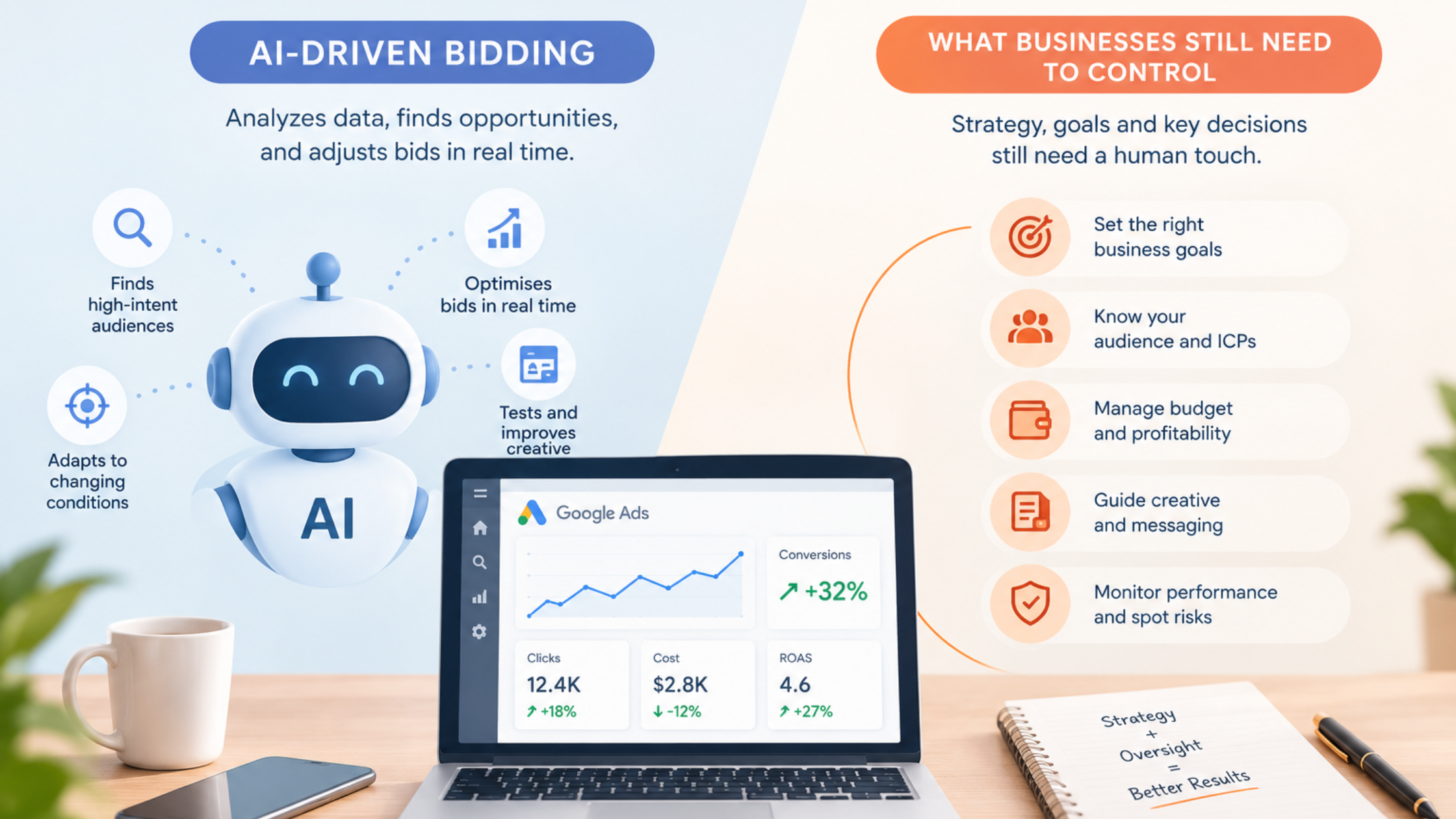
Despite increasing automation, successful search advertising still requires human expertise.
AI can identify patterns faster than any individual marketer.
It can process vast amounts of search behaviour and make optimisation decisions in real time.
What it cannot do is fully understand business context.
It does not know:
- Which customers are most profitable
- Which services have the highest margins
- Seasonal business priorities
- Sales team capacity
- Strategic growth goals
These decisions remain firmly in the hands of marketers and business owners.
The strongest results often come from combining AI-driven optimisation with human judgement.
AI handles the scale.
People provide the strategy.
The same principle applies to SEO services, where AI can assist with optimisation and analysis, but strategic direction and business alignment still require human expertise.
Common Mistakes Advertisers Make With AI Max
Many businesses adopt new Google features expecting them to work automatically.
In practice, several mistakes repeatedly undermine performance:
- Enabling Automation Without Reviewing Tracking
If conversion data is flawed, campaign optimisation will be flawed.
- Focusing Only on Lead Volume
Higher lead numbers do not necessarily translate into higher revenue.
- Ignoring Search Term Insights
AI Max expands targeting significantly. Reviewing search term reports remains critical for understanding where budget is being spent.
- Scaling Too Quickly
Early performance improvements should be validated before significant budget increases are introduced.
- Accepting Every Recommendation
Google’s recommendations can provide useful guidance, but they should support decision-making rather than replace it.
Preparing for the Future of AI-Powered Search
Google’s direction is clear.
Search advertising is becoming increasingly AI-driven, and automation will continue to expand across targeting, creative development, bidding, and campaign management. Dynamic Search Ads are already being transitioned into AI Max, reinforcing Google’s long-term commitment to this approach.
Advertisers who embrace these tools thoughtfully will likely gain access to new opportunities and efficiencies.
Those who treat automation as a set-and-forget solution may struggle with wasted spend, declining lead quality, and reduced visibility into campaign performance.
The businesses that succeed will be the ones that build strong foundations first.
Final Takeaway
AI Max for Search offers genuine potential to improve campaign performance and uncover new customer opportunities.
But AI is not a replacement for sound marketing fundamentals.
Before turning on AI-powered features, ensure conversion tracking is accurate, lead quality is measurable, landing pages are relevant, and business objectives are clearly defined.
Advertisers should also prioritise website performance optimisation, as faster and more relevant landing page experiences can significantly improve conversion outcomes generated through AI-driven traffic.
The role of advertisers is changing, not disappearing.
In 2026, competitive advantage comes from combining Google’s AI capabilities with strategic oversight, reliable data, and ongoing optimisation.
AI can accelerate performance, but human expertise remains what keeps campaigns aligned with business outcomes.
Related Articles

Why Choose Us?
With decades of experience and a dedicated team, we are committed to delivering high-quality web development services. Our client-centric approach ensures that we understand your needs and provide solutions that exceed your expectations.