


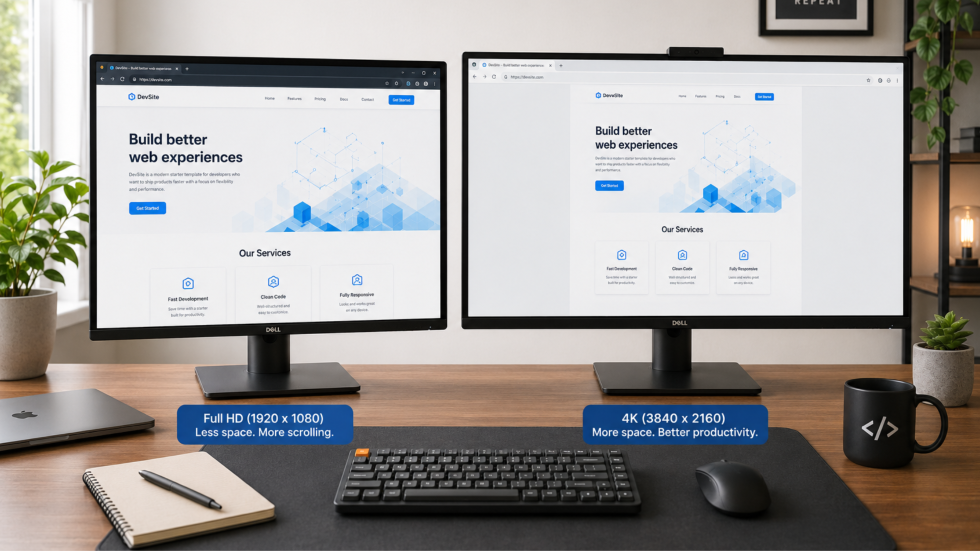

As agencies and development teams focus on improving efficiency, investments often revolve around software, automation, or new processes. Hardware upgrades can easily fall down the priority list.
However, the equipment your team works on has a direct impact on the quality of what they deliver.
With more clients now reviewing websites and digital products on 4K displays—particularly on Macs—development teams using older or lower-resolution monitors may not be seeing the same experience as their clients. That gap can lead to unnecessary revisions, overlooked design issues, and slower project delivery.
Choosing the right 4k monitor for developers helps teams evaluate digital products in the same high-resolution environments their clients increasingly use.
Upgrading development workstations with 4K monitors isn’t simply about sharper screens. It’s about matching the environment your clients use every day.
The Client’s Screen Is the New Standard
Many businesses now use premium laptops and external monitors with 4K or higher resolutions as their primary workstations. Apple devices have also become increasingly common across creative agencies and marketing teams, where high pixel density makes visual quality far more noticeable.
For developers, this changes the way websites need to be reviewed.
A layout that appears balanced on a standard Full HD display can look noticeably different on a larger, high-resolution monitor. Images that seem perfectly acceptable during development may appear soft or blurry, particularly on Retina displays where pixel density is much higher.
The issue isn’t that the website is broken—it simply hasn’t been reviewed in the same environment as the client.
One of the key 4k monitor benefits is that developers can detect visual inconsistencies earlier, helping improve quality before projects reach final approval.
Responsive Design Doesn’t End at Desktop
Responsive development traditionally focuses on mobile, tablet, and desktop breakpoints.
But today’s desktop experience isn’t as straightforward as it once was.
Large 27-inch and 32-inch 4K monitors provide significantly more screen space than traditional office displays. Clients reviewing a website on these monitors may notice:
- Content appearing too narrow or undersized
- Large empty spaces that reduce visual impact
- Images that lack sufficient resolution
- Typography and spacing that feel inconsistent
- Hero banners that don’t scale well on larger displays
Modern responsive design increasingly considers larger desktop viewports alongside traditional breakpoints, especially for audiences likely to use premium displays.
For teams delivering corporate website development projects, testing across larger and higher-resolution displays is becoming an essential part of creating polished digital experiences.
Without testing in those environments, these issues may only become apparent after client feedback.
Better Testing Means Fewer Revisions
One of the biggest costs in any project isn’t fixing bugs—it’s rework.
When clients identify visual issues that weren’t spotted internally, projects often require additional QA cycles, developer time, design reviews, and communication.
Providing developers with the same class of displays used by clients allows teams to identify these issues earlier.
Instead of reacting to feedback, teams can proactively validate:
- Image quality on high-density displays
- Layout behaviour across larger desktop sizes
- Scaling of UI components
- Visual balance and whitespace
- Overall presentation quality
Finding these issues before handover improves efficiency while creating a smoother experience for both agencies and clients.
Investing in a quality display also supports website performance optimisation efforts because developers can better evaluate how assets, layouts, and visual elements perform in real-world conditions.
Supporting High-Resolution Assets
Mac users are particularly sensitive to image quality because Retina displays make lower-resolution graphics much easier to spot.
Icons, logos, banners, and featured images that look acceptable on standard monitors may appear noticeably softer on high-density screens.
As a result, development teams increasingly need to validate:
- Higher-resolution imagery
- SVG assets where appropriate
- Responsive image loading
- Proper image optimisation without sacrificing clarity
Having access to 4K displays during development makes these quality checks significantly easier.
For businesses investing in professional business websites, ensuring visual consistency across premium devices can strengthen brand perception and improve user confidence.
A Real-World Example
One common scenario involves US-based clients reviewing websites on MacBooks connected to large 4K monitors.
From the development team’s perspective, the website may appear complete.
From the client’s perspective, however, several issues become immediately visible:
- Images appear blurry.
- Sections feel too narrow.
- Large monitors expose excessive whitespace.
- Overall presentation feels smaller than expected.
These aren’t functional defects—they’re differences in viewing environments.
When developers can review projects under similar conditions before delivery, these issues are far less likely to reach the client.
For teams providing corporate web development services, matching client viewing environments helps create more reliable review processes and reduces unexpected design feedback.
Are 4K Monitors Worth It for Development Teams?
Many development teams consider whether upgrading their existing displays is necessary, especially when current monitors still function properly.
The question “are 4k monitors worth it” depends on how frequently teams review visual projects, but for developers working on modern websites and digital products, the benefits often extend beyond improved image clarity.
A 4K monitor provides additional workspace, sharper visuals, and a more accurate representation of how websites appear on modern client devices. This is especially valuable when working with complex layouts, detailed interfaces, large images, and high-resolution design assets.
For developers, designers, and QA teams, the investment can improve productivity by allowing more content to be displayed at once while reducing the need to constantly zoom, resize, or switch between windows.
When evaluating whether are 4k monitors worth it for your team, the biggest consideration is not only screen resolution—it is whether your development environment reflects the expectations of the people reviewing the final product.
It’s an Investment in Quality, Not Just Hardware
A 4K monitor isn’t simply another office upgrade.
It’s a quality assurance tool.
Just as agencies invest in testing across multiple browsers and mobile devices, investing in displays that reflect real client environments improves confidence before launch.
It also supports better collaboration between designers, developers, and QA teams by ensuring everyone is reviewing the same experience.
Considering that there are now more than 1.38 billion websites online and users increasingly expect polished, visually consistent digital experiences, small presentation issues can quickly influence perceptions of quality.
For organisations managing complex digital projects, combining high-quality equipment with tailored development solutions can help teams deliver more consistent results across different platforms and devices.
Supporting Better Digital Delivery
Modern development teams are responsible for more than simply making websites function correctly. They must ensure digital experiences are visually appealing, accessible, responsive, and aligned with client expectations.
A strong testing environment supports this process by allowing teams to identify issues before launch rather than after feedback from customers or stakeholders.
Businesses investing in custom business web solutions benefit when development teams have the right tools to review designs, performance, and usability from the earliest stages.
High-resolution displays can also improve communication between teams. Designers can confirm whether visual concepts translate accurately into development, while developers can verify that implementation matches the intended experience.
Better alignment between teams leads to fewer misunderstandings, faster approvals, and smoother project delivery.
Final Thoughts
The tools a development team uses influence the quality of every project they deliver.
As client hardware evolves, development environments should evolve alongside it.
Equipping teams with 4K monitors helps bridge the gap between internal testing and real-world client experiences. It enables developers to identify layout, responsiveness, and asset quality issues earlier, reducing revisions and improving the overall delivery process.
Ultimately, investing in the right equipment isn’t about keeping up with technology—it’s about ensuring the work delivered meets the expectations of today’s clients from the very first review.
Related Articles




Why Choose Us?
With decades of experience and a dedicated team, we are committed to delivering high-quality web development services. Our client-centric approach ensures that we understand your needs and provide solutions that exceed your expectations.