


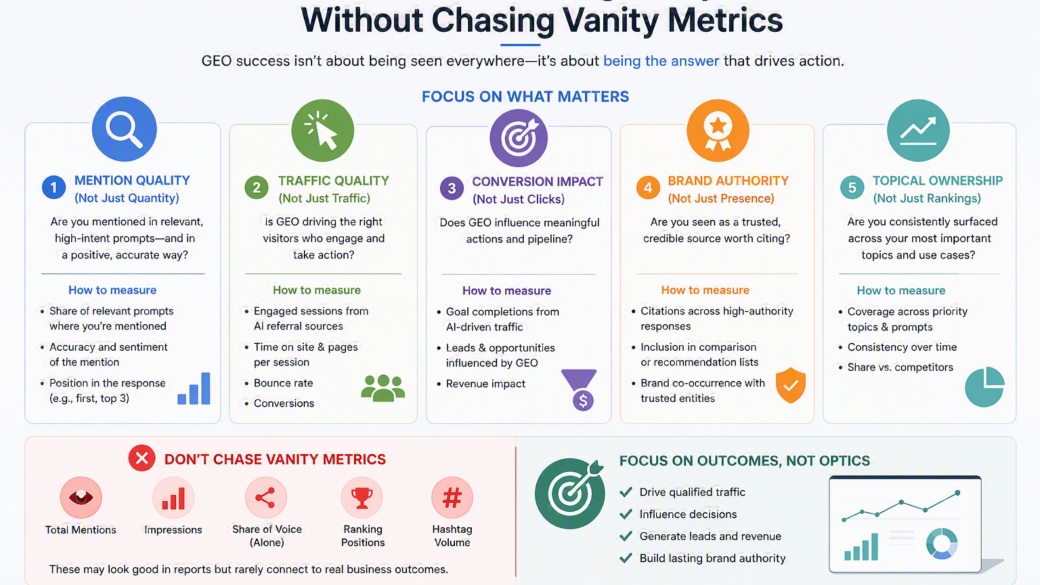
How to Measure Generative Engine Optimisation (GEO) Without Chasing Vanity Metrics

Generative AI is changing how people research products, services and suppliers. Rather than clicking through pages of search results, more users are asking AI assistants like ChatGPT, Gemini and Perplexity for recommendations and summaries before they ever visit a website. This rise in conversational search means brands must adapt to an era of zero-click search optimisation.
That shift has sparked growing interest in Generative Engine Optimisation (GEO) – the practice of improving a brand’s visibility within AI-generated answers. But while many businesses are eager to appear in these responses, far fewer know how to measure whether those appearances are actually creating value.
Unlike traditional SEO, GEO doesn’t have established reporting standards or a single metric that proves success. If you are currently partnering with an agency for SEO services, you know how critical clear reporting is. That’s why it’s important to focus on business outcomes rather than vanity metrics when building a modern AI search marketing plan.
GEO measurement is still evolving
Search Engine Optimisation has always been relatively straightforward to measure. Rankings, organic traffic, impressions and conversions all provide tangible indicators of performance.
GEO is different.
AI platforms don’t currently provide detailed analytics showing how often your brand appears in responses or how those mentions influence customer behaviour. Attribution is also much harder because users often complete much of their research inside an AI interface before eventually visiting your website—or contacting you directly.
That doesn’t mean GEO can’t be measured. It simply requires a broader view of performance.
Start with visibility, not volume
The first step in AI visibility optimisation is establishing where your brand currently appears in AI-generated responses.
Useful questions include:
- Which AI platforms mention your business?
- Which competitors appear alongside you?
- What types of questions generate those recommendations?
- Does the AI already seem familiar with your brand before someone asks directly?
This creates a baseline for your search visibility strategy that can be revisited over time.
However, one of the biggest mistakes organisations make with Generative Engine Optimisation is treating the number of AI mentions as the primary measure of success.
More mentions don’t automatically mean better results.
The quality of the questions matters far more than the quantity.
For example, appearing when someone asks:
“Best time tracking software for law firms”
is significantly more valuable than appearing in a general discussion about productivity software.
The first query reflects a specific business need and much stronger buying intent. The second is simply informational. Both increase visibility, but only one is likely to influence a purchasing decision.
Look for business signals
Because AI attribution is still limited, many of the strongest GEO indicators come from broader business metrics rather than AI platforms themselves.
These include:
- Growth in branded search volume.
- Improvements in lead quality.
- More qualified enquiries.
- Sales conversations where prospects already understand your offering.
- Increased direct traffic from users who have already completed much of their research.
Rather than asking, “How many times were we mentioned?”, a better question is:
“Are we seeing stronger demand from better-informed prospects?”
This approach aligns SEO reporting more closely with business performance instead of focusing exclusively on rankings and clicks.
Use GEO alongside traditional SEO
It’s important not to think of GEO as replacing SEO.
Search engines still drive significant traffic, and traditional optimisation remains essential. According to industry research, Google continues to process billions of searches every day, while AI-powered search is growing rapidly as users adopt new ways to research products and services.
Instead, GEO should complement existing SEO reporting.
A balanced reporting framework might include:
- Organic rankings.
- Organic Search traffic.
- Conversion rates.
- AI visibility for priority commercial questions.
- Competitor presence in AI responses.
- Branded search trends.
- Lead quality and sales outcomes.
Looking at these metrics together provides a more realistic picture of how search visibility influences business growth. If your current organic baseline is struggling, leveraging specialised technical SEO services is the best way to ensure your site’s foundation is readable by both human users and AI crawlers.
Be careful with revenue attribution
Perhaps the biggest temptation is trying to assign an exact dollar value to GEO.
At this stage, that’s difficult—and often misleading.
Customer journeys have become increasingly complex. Someone might first discover your business through an AI assistant, later perform a branded Google search, read reviews, visit your website multiple times and finally convert after speaking with your sales team.
Which interaction deserves the credit?
In reality, they all contributed.
Rather than claiming that one AI mention generated one sale, it’s more accurate to treat GEO as an influence on demand generation.
The objective isn’t perfect attribution. It’s understanding whether improved AI visibility is helping your brand enter the buying journey earlier and creating more opportunities with qualified prospects.
Being transparent about this uncertainty also builds credibility with stakeholders. Revenue estimates should always be clearly identified as directional rather than definitive.
The practical approach
For businesses investing in GEO today, the most sensible strategy is to establish a baseline before making significant changes.
Track:
- Where your brand currently appears.
- Which competitors are recommended.
- Which commercial questions generate mentions.
- Changes in branded search behaviour.
- Improvements in enquiry quality and sales conversations.
Review these trends over time rather than expecting immediate, perfectly measurable returns. If your site’s infrastructure is slow or outdated, AI crawlers may struggle to index your content. Securing reliable technical website maintenance is highly recommended to keep your pages fast, structured, and accessible.
Similarly, if you are planning to launch a new brand presence to capture this market, utilising experienced corporate web development services ensures your platform is built from day one with schema markup and clean code optimised for both search engines and LLMs.
As AI search platforms continue to mature, reporting capabilities will almost certainly improve. Businesses that establish measurement frameworks now will be in a much stronger position to understand what drives visibility—and, ultimately, business growth.
Final takeaway
Generative Engine Optimisation is creating new opportunities for businesses to be discovered, but measuring success requires a shift in mindset.
The goal isn’t simply to accumulate AI mentions. It’s to become visible when potential customers are asking meaningful, high-intent questions that influence purchasing decisions.
By combining traditional SEO metrics with broader business indicators such as branded searches, lead quality and sales outcomes, organisations can build a reporting framework that reflects real commercial impact—even while GEO measurement continues to evolve.
Related Articles



Why Choose Us?
With decades of experience and a dedicated team, we are committed to delivering high-quality web development services. Our client-centric approach ensures that we understand your needs and provide solutions that exceed your expectations.