


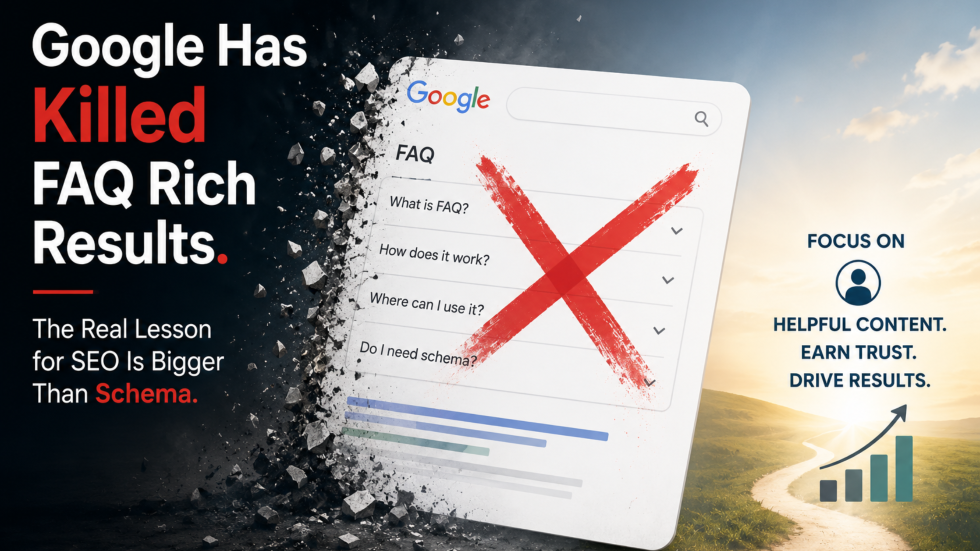
Google Has Killed FAQ Rich Results. The Real Lesson for SEO Is Bigger Than Schema

Google has officially removed FAQ rich results from Search, bringing an end to one of the most widely used structured data features in Search engine optimisation. As of May 2026, FAQ snippets no longer appear in search results, regardless of whether a page includes FAQ schema markup. Google is also retiring related reporting from Search Console and the Rich Results Test.
For many marketers, this feels like the loss of another useful SEO tactic. But the real story is much bigger than FAQ schema.
This change highlights a pattern that has been unfolding for years: Google is steadily reducing opportunities to gain visibility through search features and increasingly rewarding content quality over technical shortcuts.
The removal of FAQ rich results isn’t the problem. It’s the latest example of a strategy reaching its expiry date.
The Rise and Fall of FAQ Schema
FAQ schema was originally introduced as a way to help Google better understand question-and-answer content.
In theory, it improved the search experience. In practice, it quickly became something else.
Businesses realised that adding FAQ markup could dramatically increase the amount of screen space their listings occupied in search results. Pages that previously appeared as a standard blue link suddenly displayed multiple expandable questions underneath.
The result was predictable.
Many professional business websites started adding FAQ sections to pages where they weren’t genuinely needed. Questions were written for search engines rather than users. In some cases, FAQs repeated information already present elsewhere on the page simply to trigger a larger search result.
The focus shifted from helping users to taking up more space.
That’s usually a sign a tactic won’t last forever.
Google first restricted FAQ rich results in 2023, limiting them primarily to government and health websites as part of an effort to simplify search results. The complete removal announced in 2026 is simply the final step in that process.
Every SEO Strategy Has an Expiration Date
One of the biggest mistakes teams make is assuming that a successful SEO tactic that improve search rankings is a permanent advantage.
History suggests otherwise.
Keyword stuffing worked until it didn’t.
Directory submissions worked until they didn’t.
Mass link exchanges worked until they didn’t.
FAQ rich results followed the same pattern.
The visibility boost was never really about creating better content. It was about taking advantage of a feature Google happened to be offering at the time.
When enough people optimise for the feature rather than the user, Google eventually adjusts.
That’s not unusual. It’s how Organic search has always evolved.
The businesses that struggle most during these shifts are often the ones that built their SEO strategy around the feature itself. The businesses that adapt tend to be the ones focused on delivering value regardless of which search features happen to be available.
This Isn’t Happening in Isolation
It’s tempting to view FAQ rich results as a standalone change.
It’s not.
Over the past several years, Google has gradually reduced the amount of organic real estate available on the search results page.
We’ve seen:
- More advertisements appearing above organic listings
- AI Overviews occupying prime screen space
- Fewer opportunities for enhanced organic results
- Increased emphasis on Google’s own answer experiences
FAQ rich results are simply another casualty in a broader shift.
Google’s search results are becoming less generous with free visibility.
For businesses that rely heavily on organic traffic, that reality is becoming harder to ignore.
The challenge isn’t that SEO is disappearing. It’s that earning attention is becoming more competitive, while Google increasingly controls how information is presented to users.
Don’t Delete Your FAQ Content
There’s an important distinction that many site owners are missing.
The markup is gone.
The content format is not.
Good FAQ content still serves a valuable purpose.
People ask questions before they buy products, engage services, or make decisions. Well-written FAQ sections help address those questions clearly and efficiently.
They’re also well suited to the way modern search experiences operate.
AI-generated answers, including Google’s AI Overviews, frequently rely on content that presents information in a direct and structured format. Clear questions followed by concise answers are naturally aligned with that approach.
The mistake would be removing genuinely useful FAQ content simply because the rich result no longer exists.
Instead, businesses should ask a more important question:
Why was the FAQ section there in the first place?
If the answer is “to help users find information quickly”, it still has value.
If the answer is “to get a bigger search listing”, it may never have been earning its place on the page.
A Better Way to Audit Your Content
For agencies and marketing teams reviewing their websites after this change, the goal shouldn’t be to remove schema and move on.
Use it as an opportunity to evaluate content quality.
For every FAQ section on your site, ask:
- Does this answer a genuine customer question?
- Would a visitor find this useful even if search engines didn’t exist?
- Is the answer clearer than what’s already on the page?
- Does this improve the user experience?
If the answer is yes, keep it.
If not, consider whether that content is contributing meaningful value.
This approach often leads to stronger pages overall because it shifts the focus away from search features and back toward user needs.
The Real Lesson
The removal of FAQ rich results might feel like an SEO story, but it’s really a strategy story.
Features come and go.
Search layouts change.
Algorithms evolve.
The businesses that consistently survive these changes aren’t chasing every new opportunity to gain a few extra pixels in Organic search results.
They’re creating content that solves real problems, answers genuine questions, and helps users make better decisions.
That’s what Google has been moving towards for years.
Ironically, the format many marketers adopted for a visibility boost — clear questions and direct answers — is still incredibly valuable today.
The difference is that now the content itself matters more than the markup attached to it.
And that’s probably where the focus should have been all along.
Related Articles





Why Choose Us?
With decades of experience and a dedicated team, we are committed to delivering high-quality web development services. Our client-centric approach ensures that we understand your needs and provide solutions that exceed your expectations.