


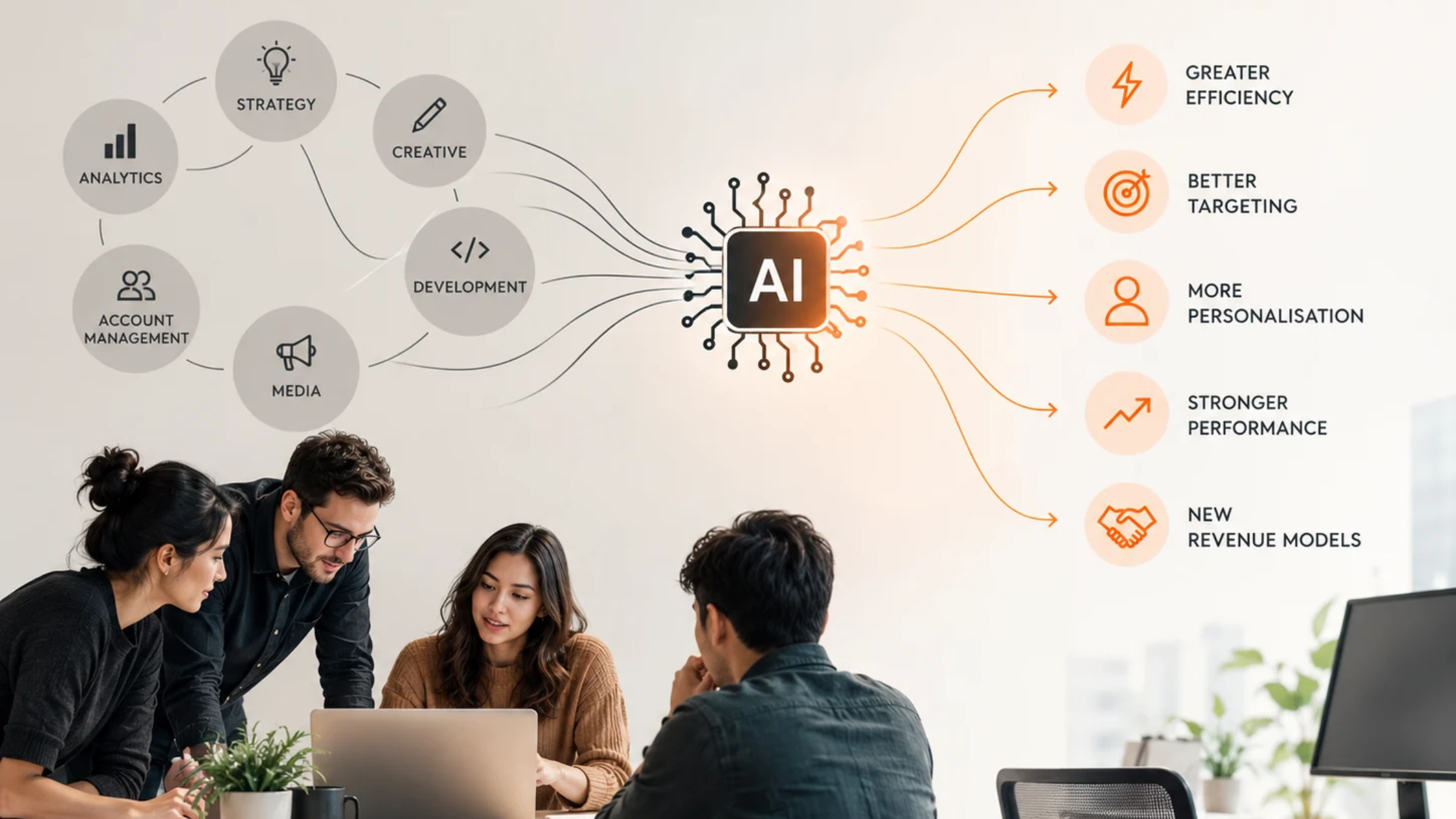

AI is quickly becoming part of everyday agency work. From content creation and research to development and project management, tasks that once required hours of manual effort can now be completed in a fraction of the time.
The growing adoption of ai for agencies is creating opportunities to improve efficiency, streamline operations and rethink how services are delivered.
That should be good news for agencies. Yet the commercial picture is more complicated.
Clients are scrutinising budgets, new business can be difficult to secure, and agencies are under pressure to demonstrate the value they deliver. At the same time, clients have access to many of the same AI tools as their agency partners.
The question is no longer simply how agencies can use AI to work faster. It is what those productivity gains mean for the way an agency operates, earns revenue and creates value for its clients.
Using AI is not the competitive advantage. The advantage comes from how intelligently an agency changes its business around it.
From experimenting with tools to rethinking the work
In recent conversations with agency owners across Brisbane and Melbourne, one theme has been consistent: almost everyone is using AI in some capacity, but many are still working out what it means for their business.
Claude and other AI platforms are being used for content creation, research, ideation, development, meeting summaries, documentation and internal processes. These are sensible places to start. They can remove repetitive work, accelerate delivery and give teams more time for other priorities.
The increasing availability of ai tools for agencies makes it easier to automate routine processes, but choosing the right tools requires a clear understanding of how they support existing workflows.
However, there is an important distinction between making an existing process faster and questioning whether that process still makes sense.
If a task that previously took five hours can now be completed in one, the immediate benefit is obvious. But the bigger questions are commercial and operational.
Should the agency still charge for the same number of hours? Can the time saved be redirected towards higher-value work? Does the service need to be packaged differently? And could the client now complete some of that work themselves?
These are questions about the agency’s business model, not its software subscriptions.
Understanding how agencies are using ai beyond basic task automation can help business owners identify opportunities to improve service delivery and create greater value for clients.
The distinction matters. McKinsey’s 2025 global AI research identified workflow redesign as an important factor associated with organisations achieving business value from generative AI. The implication for agencies is straightforward: introducing a tool is only part of the job. How the work is organised around it matters too. Source: McKinsey, The State of AI: How Organizations Are Rewiring to Capture Value.
The pressure on traditional agency pricing
Hourly billing becomes more complicated when AI changes how long work takes.
Consider a hypothetical content project that previously required five hours of research, drafting and editing. With an effective AI-assisted workflow, the same deliverable might take one or two hours of production time, plus the necessary human review and strategic input.
If the agency charges purely for time spent, it may earn less for delivering essentially the same result. If it maintains the original fee without explaining the value behind it, the client may question the difference.
Neither outcome is ideal.
This does not mean hourly billing will disappear, or that every AI-assisted task should cost less. It means agencies need to be clearer about what clients are actually paying for.
As production becomes more efficient, developing an ai agency business model that reflects expertise, outcomes and client value becomes an important consideration for long-term profitability.
Depending on the service, alternatives could include:
- Fixed project fees: Pricing an agreed scope and outcome rather than every hour required to complete it.
- Retainers: Providing ongoing access to expertise, optimisation and delivery capacity.
- Value-linked engagements: Connecting the scope of work to meaningful commercial objectives, where those objectives can be defined and measured appropriately.
- Specialist advisory services: Charging for diagnosis, strategic direction and expert decision-making alongside implementation.
Each model has trade-offs. Fixed fees require disciplined scope management, retainers need a clear definition of ongoing value, and outcome-based arrangements depend on measurable objectives and an appropriate allocation of risk.
The point is not to abandon hourly billing overnight. It is to understand how AI affects delivery economics and decide which pricing approach best reflects the value being provided.
Agencies should also track the difference between time saved and profit gained. Productivity improvements do not automatically translate into better margins. The result depends on how the agency uses that additional capacity, prices its work and manages demand.
If clients have the same tools, why hire an agency?
This is one of the more important questions agency owners need to consider.
A client can ask AI to generate a marketing strategy. It can produce a content calendar, draft a landing page or generate code. But the ability to produce an answer does not guarantee that the answer is right.
A strategy can be coherent but commercially misguided. Content can be well written but indistinguishable from competitors’ work. Code can function while creating problems for security, maintainability or the wider technology stack.
This is especially important in website performance optimisation, where technical expertise and ongoing monitoring help maintain a reliable and efficient website.
The gap is between generating an output and knowing what should be produced in the first place.
This distinction is particularly relevant to ai for digital agencies, where successful campaigns and strategies depend on more than generating content or automating individual marketing tasks.
Experienced agencies bring context to that decision. They understand the client’s market, audience, commercial constraints and existing systems. They can challenge assumptions, weigh competing priorities and recognise when an apparently attractive solution is unlikely to work.
They also take responsibility for quality and delivery.
That combination of judgement, specialist knowledge and accountability becomes increasingly important as production itself becomes easier.
The value of an agency should therefore be measured less by how many deliverables it produces and more by how effectively it helps clients make decisions and achieve their objectives.
This also changes the conversation during a pitch. Rather than competing on production volume alone, agencies can demonstrate how they identify problems, make informed recommendations, manage implementation and assess whether the work is delivering the intended result.
Efficiency can quickly become commoditisation
There is a risk in treating AI primarily as a cost-saving exercise.
When multiple agencies use similar tools and workflows to produce similar outputs, the efficiency advantage can be short-lived. If everyone can create an acceptable first draft quickly, the draft itself becomes less valuable as a differentiator.
The same principle applies across design, development, research and other production services. As certain capabilities become more accessible, clients may find it easier to compare providers on price or bring simpler tasks in-house.
While ai for agencies can reduce production costs, relying on the same automated processes as competitors may make it harder to stand out in an increasingly competitive market.
Forrester’s June 2026 research on US marketing agencies highlights this tension. Its findings warn that an industry-wide focus on AI-driven productivity and cost efficiency can undermine creativity, marketing effectiveness and long-term brand growth when differentiation is neglected. Source: Forrester, Nine In 10 US Marketing Agencies Use AI To Cut Costs At The Expense Of Creativity.
The lesson is not that agencies should avoid efficiency. It is that efficiency needs to support something more valuable.
That might mean investing the time saved into stronger creative thinking, better research, more rigorous quality assurance or a deeper understanding of a client’s business.
It could also mean specialising in a particular industry, technical capability or business problem rather than offering an increasingly broad range of interchangeable services.
AI can make delivery more efficient. It cannot, by itself, make an agency distinctive.
What happens to agency teams?
As production changes, team structures and responsibilities will need to evolve.
Some repetitive tasks may require less manual effort. Certain roles may spend less time producing first drafts or completing routine technical work and more time reviewing outputs, solving problems and making decisions.
This does not mean every agency needs to reduce headcount or replace experienced people with AI. In many cases, the opportunity may be to increase capacity without expanding the team at the same rate, or to redirect existing skills towards work clients value more highly.
For example, outsourcing website maintenance services can help agencies manage ongoing technical responsibilities while allowing internal teams to focus on strategic priorities.
Examining how agencies are using ai across different departments can help leaders determine which responsibilities can be streamlined and where employees can contribute more strategically.
The skills that matter will also shift.
Agencies will still need people who understand their disciplines in depth. In fact, expertise becomes particularly important when someone needs to recognise a plausible but incorrect AI-generated answer.
Alongside technical and creative capability, valuable skills are likely to include:
- Strategic thinking and commercial understanding.
- The ability to assess and improve AI-generated work.
- Clear communication with clients and internal teams.
- Workflow design, process improvement and quality assurance.
- Problem-solving across disciplines and systems.
- The judgement to know when AI is useful — and when it is not.
For agency leaders, the challenge is to decide which responsibilities should change, which skills need developing and where human involvement remains essential.
Team design should follow the work the agency wants to deliver, rather than simply follow the capabilities of the latest tool.
How agencies can start rethinking their operating model
There is no need to wait for a perfect AI strategy before taking action. A practical starting point is to examine how the agency currently operates.
1. Map the existing workflows.
Identify recurring tasks across research, content, design, development, reporting and project management. Look for bottlenecks, duplicated effort and work that relies heavily on manual processing.
2. Test specific improvements.
Choose a few well-defined use cases and compare the AI-assisted process with the existing one. Measure time saved, quality, rework and the level of human oversight required. Faster output is useful only if the result remains fit for purpose.
When evaluating ai tools for agencies, prioritise solutions that address specific operational challenges rather than adopting new technology simply because it is available.
3. Review the commercial impact.
Work out how productivity gains affect delivery costs, margins, capacity and client pricing. Decide whether saved time should support better margins, more strategic work, additional client value or a combination of these.
Building a sustainable ai agency business model requires agencies to assess whether efficiency improvements are translating into stronger financial performance and better client outcomes.
4. Reassess services and positioning. Identify which offerings are becoming easier to replicate and which depend on deeper expertise, relationships, creativity or accountability. Consider whether the agency should refine its service mix or move closer to strategic advice and measurable outcomes.
Specialised offerings such as technical SEO services demonstrate how agencies can combine AI-assisted workflows with human expertise to address complex client requirements.
For businesses exploring ai for digital agencies, this may involve shifting from routine content production towards more specialised services such as campaign strategy, performance analysis and marketing optimisation.
5. Set clear standards.
Establish appropriate rules for client data, privacy, intellectual property, factual checking, human approval and quality assurance. Decide who is accountable when AI contributes to an output.
6. Review the results regularly.
Treat adoption as an ongoing operational decision. Use evidence from real projects to determine what should be expanded, improved or stopped.
This approach avoids two common mistakes: adopting tools without a clear purpose, and making major structural decisions before understanding how AI affects the work.
The real opportunity is a better agency business
AI will continue to change what agencies can produce, how quickly they can produce it and how clients assess the value of that work.
Some services will become more accessible. Some production tasks will require less time. Pricing and team structures will need to adapt. Those changes deserve attention, but they do not make the agency model obsolete.
They make it more important to be clear about where the agency’s value lies.
Working with a white-label digital partner can also help agencies expand their capabilities and manage delivery demands without significantly increasing internal resources.
The strongest agencies will combine the efficiency of AI with the things that clients cannot get simply by opening the same application: experience, judgement, specialist expertise, creative thinking, reliable execution and accountability for outcomes.
The practical starting point is simple. Identify where AI can improve the work, measure the result, and then ask what else should change because of it.
The agencies that benefit most from AI will not necessarily be the ones using the most tools. They will be the ones that rethink their business most intelligently around them.
Related Articles

Why Choose Us?
With decades of experience and a dedicated team, we are committed to delivering high-quality web development services. Our client-centric approach ensures that we understand your needs and provide solutions that exceed your expectations.