


AI in PPC: What Businesses Still Need to Control as Automation Grows

AI is taking over more of the day-to-day decisions in paid search, from auction-time bidding to finding potential conversions and adapting ad combinations. But automation doesn’t remove the need for PPC strategy. The quality of the outcome still depends on the goals, conversion data, budgets and business context advertisers provide. The future of PPC management is less about controlling every bid and more about controlling what the platform is being asked to optimise towards.
Paid search has always involved a degree of automation, particularly as paid search campaigns have become increasingly automated.
The growing use of AI in PPC is accelerating this shift, giving advertising platforms more responsibility for tactical decisions while making strategic oversight even more important.
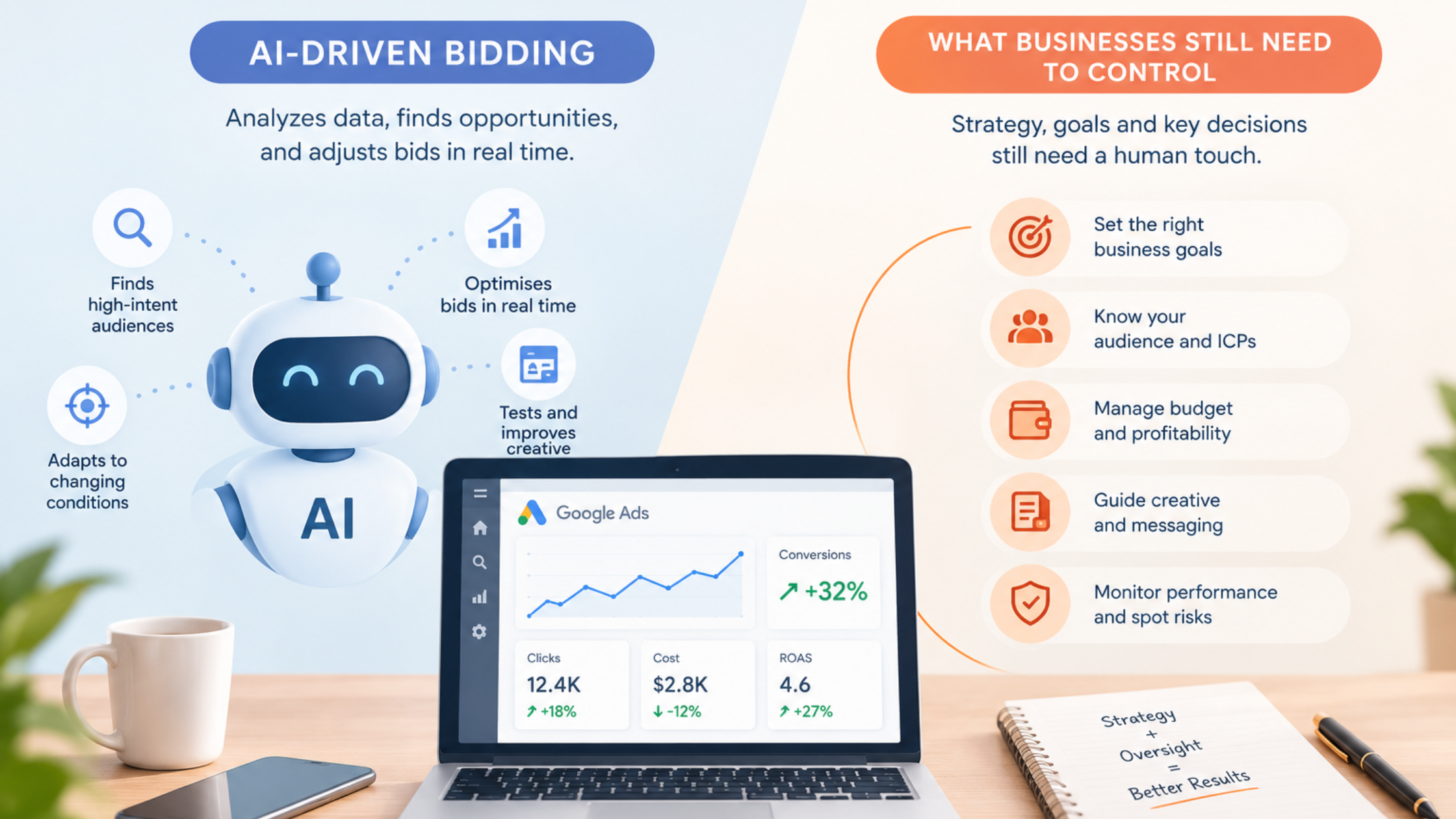
Google Ads and other advertising platforms can now make thousands of decisions that advertisers once handled manually. Rather than setting bids keyword by keyword, advertisers can use AI-powered bidding to adjust bids in real time based on signals such as device, location, time of day and other contextual information.
Google describes Smart Bidding as AI-powered bidding that optimises for conversions or conversion value at auction time. Its systems can use a wide range of signals and continuously update their predictions as performance data changes.
For advertisers wondering what is Smart Bidding in Google Ads, the simplest explanation is that it uses machine learning to adjust bids at the individual auction level based on the likelihood and value of a conversion.
That can make PPC management more efficient. It can also create a new problem: the platform can become very good at achieving the wrong goal.
The role of PPC management is therefore changing. Businesses don’t necessarily need someone manually adjusting every bid. They do need someone deciding what the system should optimise for, whether the data is reliable and whether the resulting performance actually matters to the business.
What AI can increasingly handle
The strongest use case for automation is repetitive decision-making at a scale humans cannot match.
Google’s Smart Bidding, for example, sets bids for individual auctions based on predicted conversion likelihood and a range of contextual signals. Google says its systems can make millions of unique bids per second across campaigns.
This is a core reason AI PPC management is becoming more valuable: automated systems can process signals and make decisions at a scale that would be impractical for a human PPC manager.
There are several areas where this can be useful.
Real-time bid adjustments
Instead of relying on fixed bids, AI can assess the context of each auction and adjust the bid accordingly.
The system may recognise that some searches, devices, locations or times are more likely to produce a conversion and change the bid accordingly.
This is difficult to replicate manually at scale.
Finding additional opportunities
Automation can also identify potential opportunities beyond the audiences, keywords or combinations an advertiser might have selected manually.
Google’s current approach increasingly uses AI to assess broader signals and search contexts, rather than treating individual keywords as isolated units.
That can help campaigns discover new sources of conversion volume.
Testing combinations of creative
AI can also assist with deciding which combinations of headlines, descriptions and other assets to show to different users.
Rather than expecting a PPC manager to determine one universally “best” ad, automated systems can test combinations and use performance data to influence delivery.
Optimising towards conversion goals
Advertisers can choose between strategies focused on conversion volume or conversion value.
Google’s current Smart Bidding options include Maximise conversions and Target CPA for conversion-focused objectives, as well as Maximise conversion value and Target ROAS when the value of conversions differs.
The important distinction is that the advertiser chooses the objective; the platform handles much of the optimisation.
That’s where human strategy becomes increasingly important.
The goal matters more than the bid
Imagine a business generates two types of leads through its website.
Lead A fills in a form, meets the company’s target customer profile and eventually becomes a $20,000 client.
Lead B fills in the same form but is outside the service area, has a very low budget and is unlikely to become a customer.
From the advertising platform’s perspective, both may initially look like conversions.
If the campaign is optimising simply for the number of form submissions, the system has no reason to favour Lead A.
It will do what it has been asked to do.
This is why a low CPA isn’t automatically evidence of a successful campaign.
A campaign can generate more conversions at a lower cost while producing fewer valuable customers.
Google itself recommends using conversion values when businesses need to optimise towards the value generated by different conversions. Its guidance describes value-based bidding as a way to optimise towards the business value of conversions rather than simply counting them.
In other words, effective AI in PPC depends on more than automation: the system needs a clear definition of what a valuable business outcome actually looks like.
AI can optimise the objective. It cannot decide whether you’ve chosen the right objective.
What businesses still need to control
As more tactical decisions become automated, several areas remain firmly in the strategic domain.
Business objectives
Before choosing a bidding strategy, businesses need to establish what they actually want to achieve.
Is the priority:
- More leads?
- More sales?
- Higher-value customers?
- Greater revenue?
- Better profit?
- A specific return on advertising spend?
These aren’t interchangeable goals.
Google’s own guidance maps different Smart Bidding strategies to different objectives, reinforcing the importance of choosing the strategy based on the desired business outcome.
2. Conversion tracking
Automation depends on data.
If conversion tracking is incomplete, duplicated or recording actions that don’t represent meaningful business outcomes, automated bidding can optimise around those problems.
Google specifically requires conversion tracking for Smart Bidding and recommends making sure the conversion actions used for optimisation are set up correctly.
This makes measurement infrastructure a strategic PPC concern, not just a technical setup task.
3. Budget allocation
AI can help decide how to use a campaign’s budget based on its optimisation goal.
It doesn’t know that the business has decided to prioritise one product line this quarter, protect investment in a particular market or reduce spend because operational capacity is limited.
Those decisions require business context.
A campaign might technically be capable of generating more conversions, but increasing spend isn’t necessarily the right decision if the sales team cannot handle the additional demand.
4. Lead quality and revenue
This is one of the most important areas for businesses running lead-generation campaigns.
Don’t stop at the conversion report.
Ask what happened after the conversion.
How many leads were qualified?
How many became opportunities?
How many became customers?
What was the revenue generated?
Which campaigns produced the best customers?
Where possible, connecting CRM or revenue information back into advertising platforms can give automated bidding better information about what a valuable conversion looks like.
The more accurately the system understands business value, the more useful its optimisation can become.
Don’t confuse automation with “set and forget”
One of the biggest mistakes businesses can make is assuming that AI-driven campaigns require less strategic oversight.
They require different oversight.
A PPC manager’s role increasingly shifts away from making every individual bid adjustment and towards managing the system around the bidding strategy.
Good AI PPC management therefore isn’t about handing over control completely; it’s about creating the right framework for automation and continuously checking whether the system is delivering commercially meaningful results.
That means asking:
- Is the conversion data accurate?
- Are the right actions being used for optimisation?
- Are the results generating qualified leads or genuine customers?
- Are search terms and traffic sources still relevant?
- Are automated recommendations appropriate for the account?
- Is the landing page delivering what the ad promises?
- Does the campaign still align with the wider business objective?
Google’s current Smart Bidding guidance also cautions that bidding strategies need sufficient data to learn and recommends allowing time for the system to stabilise rather than repeatedly making disruptive changes.
Automation works best when it has room to learn.
What about search terms and traffic quality?
Automation doesn’t remove the need for scrutiny.
A campaign can achieve an attractive CPA while still attracting irrelevant searches or lower-quality traffic.
This is particularly important as platforms use increasingly broad signals to identify potential opportunities.
Understanding what is Smart Bidding in Google Ads is useful, but businesses also need to understand its limitations: Smart Bidding can optimise efficiently without necessarily understanding every commercial nuance behind a conversion.
The right question isn’t simply:
“How many conversions did we get?”
It is:
“What kind of conversions did we get, and what did they contribute to the business?”
That means continuing to review search terms, audiences, placements, landing pages and lead quality alongside standard PPC metrics.
CPA and conversion volume are useful indicators. They aren’t the complete picture.
The human role is moving up the stack
This is perhaps the biggest change AI is bringing to PPC.
Historically, a large part of campaign management involved tactical optimisation: adjusting bids, refining keyword settings, testing variations and making frequent manual changes.
As those tasks become increasingly automated, the value of human expertise moves towards strategy and interpretation.
The PPC specialist increasingly needs to be able to answer questions such as:
What should we optimise for?
Which customers are actually valuable?
Where should the budget go?
Is the platform’s recommendation commercially sensible?
What does the performance data tell us about the business?
These are not simply advertising-platform questions.
They require an understanding of the client’s customers, sales process, margins, capacity and priorities.
A practical checklist for AI-driven PPC
Before handing more control to automated bidding, businesses should check the fundamentals.
- Audit conversion tracking.
Make sure the actions being counted are accurate and meaningful. - Prioritise important conversions.
Don’t give every website interaction equal weight. Decide which actions genuinely indicate business value. - Consider conversion value.
If some customers or sales are worth more than others, use value-based measurement where appropriate. - Connect downstream data.
Where possible, use qualified lead, CRM or revenue information to improve the signals available to advertising platforms. - Review traffic quality.
Monitor search terms, audiences, placements and lead quality, not just CPA. - Treat recommendations as recommendations.
Automated platform suggestions can be useful, but they still need to be assessed against the business objective. - Give the system time to learn.
Avoid constantly changing targets, budgets and conversion goals before there is enough data to evaluate performance properly.
AI isn’t replacing PPC strategy
AI is changing what good PPC management looks like.
The platforms are increasingly capable of handling the tactical complexity of bidding and delivery. That is a good thing. Advertisers should use that capability rather than spending valuable time manually controlling decisions machines can make more efficiently.
But automation doesn’t eliminate the need for expertise.
It makes the quality of the inputs more important.
A platform can optimise thousands of decisions every day, but it can only optimise towards the goals and data it is given. If those inputs don’t reflect the real value of a customer, a campaign can become very efficient at producing the wrong result.
The future of PPC isn’t necessarily humans versus AI.
It’s humans deciding what matters, and AI helping optimise how to get there.
For businesses, that means the most important PPC questions may no longer be about whether to automate.
They are about whether the business has given the automation the right objective, the right data and enough strategic oversight to make its decisions useful.
Related Articles


Why Choose Us?
With decades of experience and a dedicated team, we are committed to delivering high-quality web development services. Our client-centric approach ensures that we understand your needs and provide solutions that exceed your expectations.