


How Clear Agency Roles and Responsibilities Improve Project Delivery

Why Great Work Needs More Than Great People
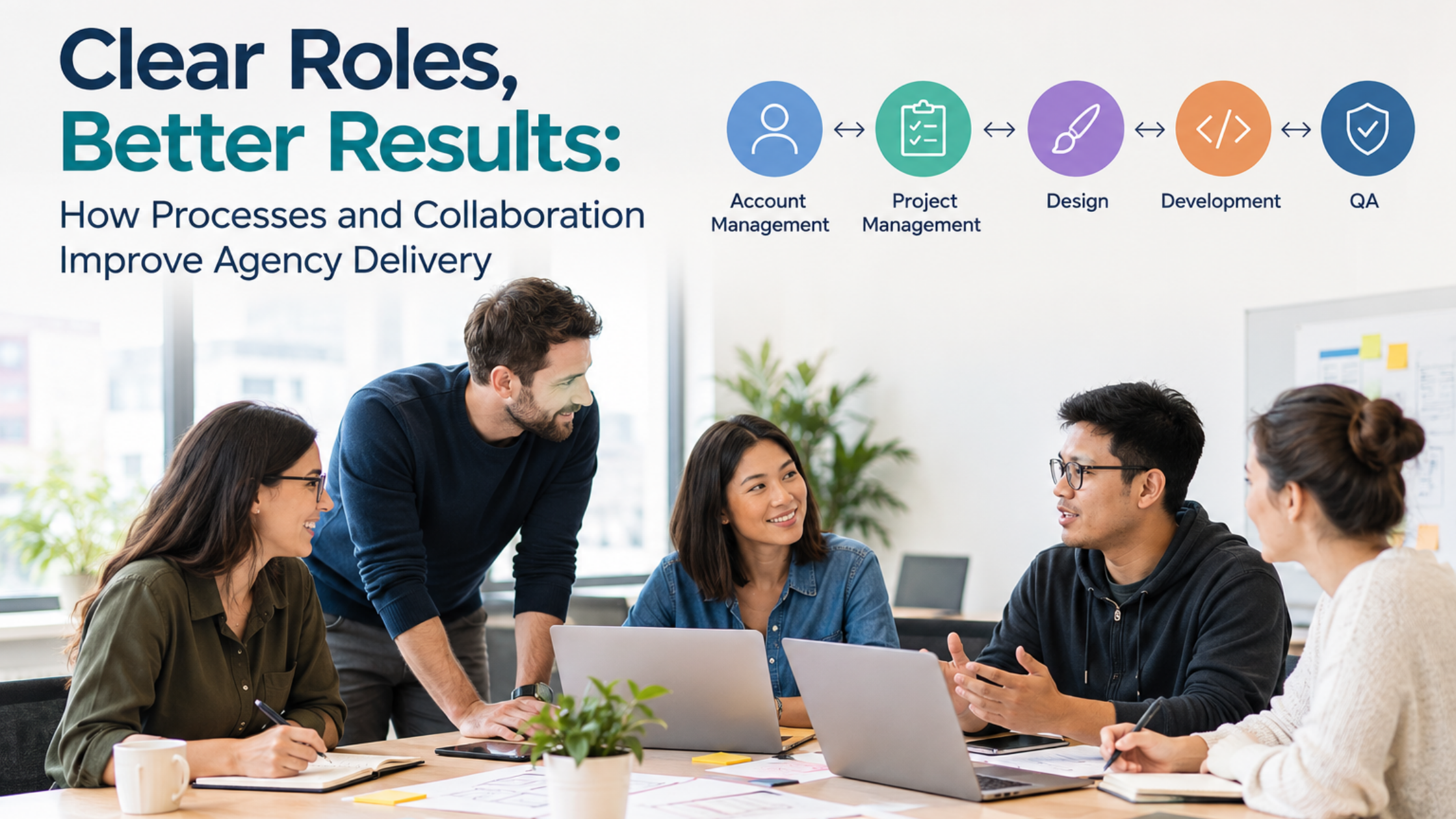
Digital agencies rely on people with different skills working towards a common outcome. Project Managers coordinate delivery, Account Managers manage client relationships, Designers develop creative solutions, Developers bring those solutions to life, and Quality Assurance (QA) Specialists check that the final product meets the required standards.
Each role brings a different perspective, but none operates in isolation.
A designer’s work affects development. Development decisions influence testing. Client feedback shapes project priorities. Project management connects these activities, helping everyone understand what needs to happen, when it needs to happen and who is responsible.
Effective agency project management helps bring these different disciplines together, ensuring that individual contributions support the broader project goals.
When these connections work well, projects move forward with fewer surprises. When they break down, even experienced teams can lose time to duplicated effort, unclear instructions, missed requirements and avoidable revisions.
For agency leaders, the challenge is not simply to hire capable people or introduce more procedures. It is to build an environment where responsibilities are understood, information flows between teams and established processes support rather than obstruct delivery.
For agencies managing increasing workloads, working with a white-label digital partner can provide access to additional expertise while allowing internal teams to focus on client relationships and project coordination.
1. Clear Roles and Responsibilities Create Better Outcomes
One of the simplest ways to improve project delivery is to make sure everyone understands their responsibilities.
Clearly defining agency roles and responsibilities gives team members a shared understanding of their contributions and helps reduce confusion throughout the project lifecycle.
In busy agency environments, role boundaries can become blurred. A Project Manager might assume a Designer has received the latest brief, while the Designer believes the Account Manager is responsible for communicating client feedback. A Developer may begin work using an earlier specification because a change was discussed but never documented.
Nobody necessarily intends to make a mistake. The problem is that assumptions have taken the place of clear ownership.
A practical starting point is to define responsibilities at key stages of a project.
- Account Managers manage client communication, clarify expectations and ensure feedback and requirements reach the relevant people.
- Project Managers coordinate timelines, resources, dependencies and delivery requirements, while keeping the team informed of progress and changes.
- Designers interpret briefs, develop creative solutions and communicate design decisions or limitations that may affect delivery.
- Developers implement agreed requirements, identify technical constraints and flag issues that could affect scope, timing or functionality.
- QA Specialists test deliverables against agreed requirements, identify defects and help ensure work meets the expected quality standard.
These descriptions provide a starting point, not rigid boundaries. Actual responsibilities will vary between agencies and projects.
The important distinction is between contributing to a task and being accountable for its completion. Several people may contribute to a deliverable, but the team should know who owns the next action, who approves the outcome and who needs to be consulted.
Regularly reviewing agency roles and responsibilities as projects evolve can also help teams adapt to changing requirements without losing sight of individual accountability.
A useful question at the start of any project stage is: Who is responsible for this, who needs to contribute, and who needs to know about the outcome?
Answering it early can prevent confusion later.
2. Communicate Before Implementing Change
Processes should evolve as projects become more complex, client expectations change and new technologies emerge. A workflow that suited a small team may no longer work when an agency manages multiple disciplines, larger delivery volumes or more complicated integrations.
However, identifying a better way to work is only the beginning. How that improvement is introduced matters just as much.
A new approval step, revised project management procedure or change to a development workflow might appear straightforward to the person proposing it. For the people using it daily, the change could introduce extra administration, duplicate an existing task or create a new handover problem.
In agency project management, even small workflow adjustments can affect multiple departments, making early communication essential to maintaining consistent delivery.
Implementing changes without consulting the affected teams can lead to inconsistent adoption. Some people follow the new procedure, others continue using the old one, and still others develop their own workarounds.
The result is not necessarily a better process. It may simply be a different source of confusion.
A more reliable approach involves four steps:
Consult.
Speak with the people who will use the process and those whose work it affects. Ask what currently works, where the problems occur and what unintended consequences the proposed change might create.
Document.
Record the agreed workflow, responsibilities, approval points and any changes to existing procedures. Make sure the information is accessible to everyone who needs it.
Agree and implement.
Confirm that affected teams understand the change, clarify who owns each step and explain when the new process takes effect. Where appropriate, trial it on a smaller scale and review the results before wider adoption.
This approach does not mean every operational decision needs lengthy consultation. The level of involvement should match the change’s impact. But when a decision affects several departments, input from those departments is essential.
The objective is not to slow improvement down. It is to make improvement more effective.
3. Accountability Is a Shared Responsibility
Clear roles help people understand their individual responsibilities, but successful delivery also depends on collective accountability.
It is easy for departments to focus exclusively on their own tasks. A Developer might complete the requested functionality, a Designer might deliver the approved layouts, and a QA Specialist might identify issues during testing. Yet the overall project can still fall short if these activities are not coordinated around the same requirements.
Accountability means more than completing an assigned task. It also means communicating when something changes, raising risks early, asking questions when information is incomplete and considering how individual decisions affect the wider project.
This is particularly important when coordinating SEO services, where content specialists, Developers and Project Managers need to align their responsibilities to ensure agreed optimisation tasks are completed effectively.
When agency roles and responsibilities are clearly established, it becomes easier to identify who should address emerging issues while encouraging everyone to contribute to the project’s overall success.
For example, if a Developer discovers that a requested feature will take longer than expected, flagging the issue early gives the Project Manager an opportunity to assess the schedule and discuss options. Waiting until the deadline is at risk leaves fewer choices available.
Likewise, if QA identifies a recurring issue, the goal should not be limited to assigning blame for the defect. The team should examine why it occurred and whether the brief, handover, implementation or testing process needs to improve.
This does not remove individual responsibility. It places that responsibility within a wider system of delivery.
Agency leaders can reinforce this mindset by encouraging people to raise concerns without fear of unnecessary blame, making escalation pathways clear and recognising those who help prevent problems rather than merely resolve them.
The best teams do not expect every project to run perfectly. They make it easier to identify issues, respond constructively and learn from the experience.
4. Collaboration Between Departments Reduces Friction
Digital projects involve dependencies. The quality of one person’s work often depends on the timing, accuracy and completeness of information received from someone else.
This is particularly important when teams are distributed across locations or work across different time zones. Informal conversations may be less frequent, and an undocumented decision can leave another team working with incomplete information.
Atlassian’s State of Teams 2024 research surveyed 5,000 knowledge workers across several markets, including Australia. It found that 55% of respondents had difficulty finding information despite knowing who might have it, while 56% said teams planned and tracked work in different ways, making collaboration harder. These findings highlight a practical challenge: having skilled people available does not guarantee that information will reach them when needed.
For agency leaders exploring how to improve team collaboration, these challenges highlight the importance of consistent communication practices and accessible project information.
For agencies, collaboration needs to be built into everyday working practices.
Useful habits include:
- Shared project records: Keep briefs, specifications, decisions, feedback and approvals in an agreed location.
- Structured handovers: Ensure the next person receives the context, assets, requirements and outstanding questions needed to continue.
- Regular, purposeful check-ins: Discuss priorities, blockers, dependencies and upcoming decisions without creating unnecessary meetings.
- Early involvement: Bring relevant specialists into discussions before decisions are finalised, especially when their expertise could identify risks or constraints.
- Clear escalation pathways: Make it easy to raise an issue and identify who can make the next decision.
Understanding how to improve team collaboration also means recognising when departments need to work together earlier, rather than waiting until problems arise during delivery.
Consider a website redesign. If development begins before the team has agreed on responsive behaviour, content requirements and design approvals, the resulting questions may trigger avoidable revisions. Involving Developers and QA earlier can surface practical constraints and testing requirements before they become expensive problems.
The same collaborative approach applies to website performance optimisation, where Developers and QA Specialists need to coordinate testing, identify technical issues and implement improvements without disrupting website functionality.
The principle is simple: collaboration should happen throughout delivery, not only when something goes wrong.
5. Make Processes Useful, Not Untouchable
Established processes provide consistency, particularly when agencies manage several projects at once. But consistency should not become resistance to change.
New tools, technologies and delivery methods can create opportunities to work more effectively. The key is to evaluate changes carefully and ensure improvements remain practical for the people doing the work.
Strong agency project management depends on processes that provide clear direction while remaining flexible enough to accommodate different project requirements and team needs.
A process review should consider three questions:
- Does it solve a real problem? Identify the specific delay, error or communication gap the change is intended to address.
- Does it work across the whole workflow? A change that saves time in one department may create extra work for another.
- How will we know it has helped? Review relevant indicators such as rework, missed handovers, approval delays, recurring defects or team feedback.
Once a process is introduced, it should not be left to interpretation. Document the agreed version, communicate updates and establish a sensible point for reviewing its effectiveness.
For ongoing technical work, such as website maintenance services, documented procedures help teams coordinate updates, manage support requests and maintain consistent quality standards.
It is equally important to avoid creating procedures for every possible situation. Excessive documentation and approval steps can make work harder rather than easier. The aim is to provide enough structure for people to make good decisions confidently, while allowing flexibility where projects require it.
Better Processes Start With Better Conversations
Reliable digital delivery is built through the interaction of people, processes and communication. Clear responsibilities help individuals understand their contribution. Consultation ensures changes account for the realities of day-to-day work. Shared accountability encourages teams to address problems constructively, while cross-department collaboration keeps everyone working towards the same outcome.
For agencies considering how to improve team collaboration, the most meaningful changes often begin with open conversations about existing challenges, shared expectations and opportunities to work more effectively.
For agency leaders, the practical starting point is straightforward: review one recurring source of confusion, involve the people affected, agree on ownership, document the solution and assess whether it improves delivery.
There is no need to overhaul every workflow at once. Small, well-considered improvements can create a more consistent way of working overtime.
Ultimately, the strongest processes are not simply written down and enforced. They are understood, agreed upon, used consistently and improved together. When teams have clarity about their responsibilities and confidence in how they work with others, they are better placed to deliver quality work reliably.
Related Articles



Why Choose Us?
With decades of experience and a dedicated team, we are committed to delivering high-quality web development services. Our client-centric approach ensures that we understand your needs and provide solutions that exceed your expectations.