


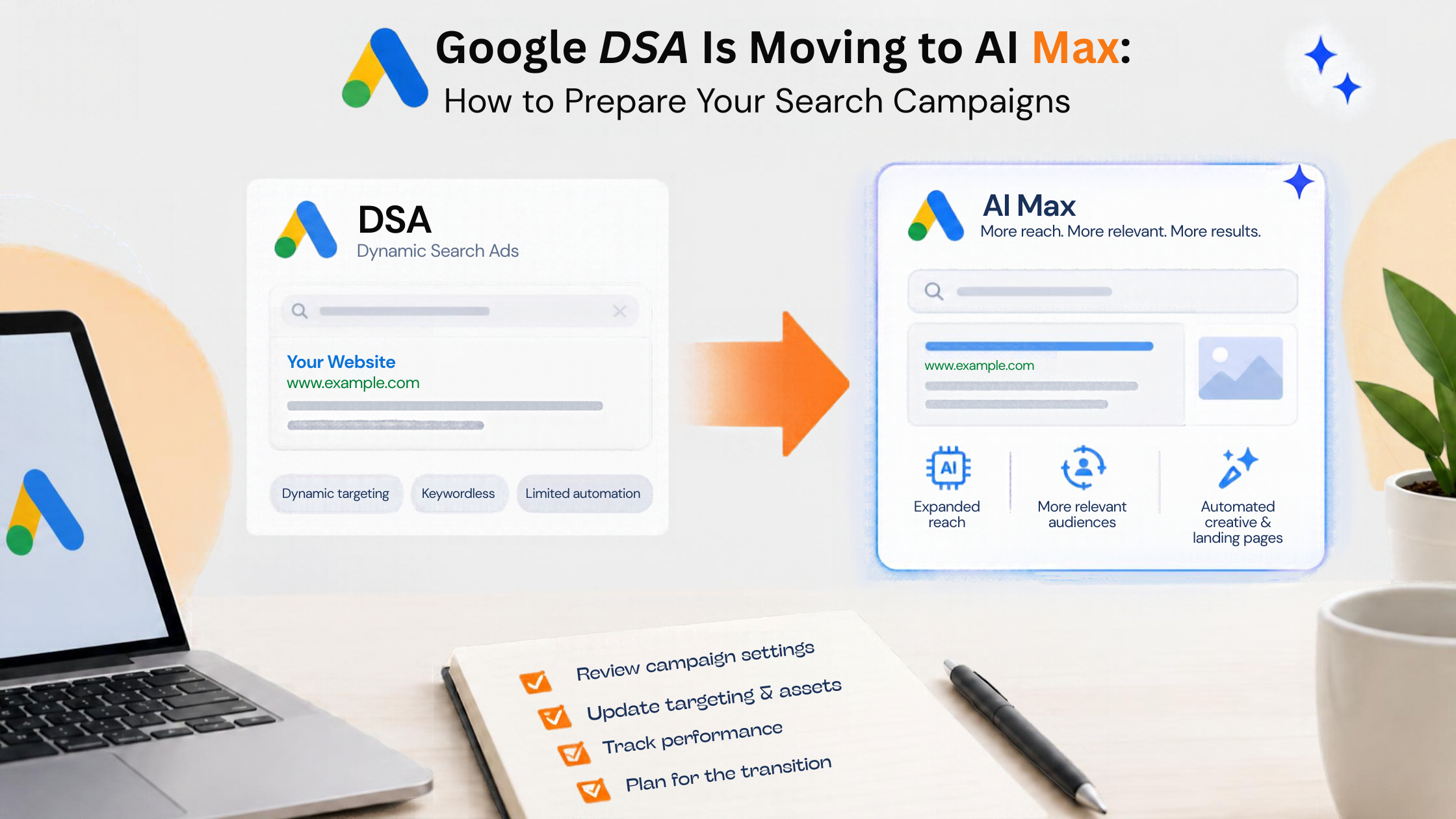
Dynamic Search Ads to AI Max: How to Prepare Your Search Campaigns

Google Ads is continuing to change how advertisers reach potential customers through Search. One of the most significant developments for advertisers using Dynamic Search Ads (DSA) is the transition to AI Max for Search campaigns.
The change offers opportunities to reach relevant searches that existing keywords might miss, while using automation to tailor ad messaging and landing pages to what people are looking for. However, greater automation also makes campaign monitoring and measurement more important.
For advertisers managing existing campaigns, understanding the transition from dynamic search ads to ai max can help them prepare for upcoming changes without disrupting performance.
For businesses that rely on Google Ads to generate enquiries and leads, the priority is not simply to adopt the latest features. It is to understand how they work, prepare campaigns for the transition and make sure any additional traffic contributes to meaningful business outcomes.
What is changing with Google DSA?
Dynamic Search Ads have traditionally helped advertisers expand their reach beyond manually selected keywords. Rather than relying entirely on a list of targeted search terms, DSA uses website content to identify relevant searches and generate headlines and landing pages.
For advertisers unfamiliar with dynamic search ads, this approach reduces the need to create individual ads for every possible search query.
This approach can be useful for businesses with extensive websites, multiple services or products, or campaigns where it is difficult to anticipate every relevant search query.
Maintaining clear website content through search engine optimisation can also support the relevance and organisation of pages used in search advertising.
AI Max builds on this concept within Google Search campaigns. It combines features designed to expand search term matching, customise ad text and direct users to relevant landing pages.
Businesses asking what is google ai max should understand that it introduces additional automation capabilities within Search campaigns rather than operating as a completely separate campaign type.
According to Google’s official announcement, the transition timeline was extended in June 2026. Automatic upgrades for campaigns using Dynamic Search Ads are scheduled to begin in February 2027.
Advertisers can upgrade eligible campaigns earlier, allowing them to review the new setup before the automatic transition.
This makes the current period a useful opportunity to audit existing campaigns, understand the available controls and plan a measured transition rather than leaving everything until the deadline.
What does AI Max offer advertisers?
AI Max introduces several capabilities that can help advertisers identify opportunities and improve the relevance of their search campaigns
1. Broader search term matching
AI Max can help campaigns reach relevant searches beyond their existing keywords. This may uncover demand from people using different language, describing a problem in an unexpected way or searching for a service using terms that are not explicitly included in the account.
For example, a business advertising commercial website development may have a defined set of keywords around web development. AI-powered matching could identify additional relevant searches that express the same need differently.
While google dynamic search ads already help advertisers capture searches beyond manually selected keywords, AI Max offers additional matching capabilities to identify potential opportunities.
The opportunity is to capture demand that might otherwise be missed. The risk is that broader matching can also introduce searches that are only loosely related to the advertised service.
Additional reach is valuable only when the traffic is relevant.
2. Automatically tailored ad messaging
AI Max can generate or adapt headlines and descriptions using information such as existing ads, keywords and landing page content.
The intention is to make the message more relevant to the search that triggered the ad, rather than relying exclusively on one fixed combination of copy.
This can save time and provide more opportunities to align messaging with customer intent. However, automatically generated content still needs oversight.
Advertisers should review the claims made on their website, ensure service descriptions are accurate and consider whether important offers, qualifications or brand messages could be misrepresented.
3. More flexible landing page selection
Final URL expansion allows Google to direct users to a relevant page on the advertiser’s website rather than always sending them to the single landing page originally specified.
This can improve the experience when a more specific service page answers a user’s question better than a general page.
Similar to dynamic search ads, this approach uses website content to help connect users with relevant pages based on their search intent.
However, not every page is suitable for paid traffic. Advertisers should consider whether pages are current, relevant, conversion-focused and appropriate for the searches they want to attract.
Regular website performance optimisation can also help ensure landing pages load efficiently and provide a better experience for visitors arriving through paid ads.
Google provides controls and reporting to help advertisers understand how these features are being used. The important step is to review the settings and results rather than assuming automation will always select the best outcome.
The biggest risk: more traffic does not always mean better leads
Expanding search reach can create opportunities, but it can also introduce irrelevant queries.
This is an important consideration for lead-generation campaigns. A campaign might generate more clicks and even more form submissions while producing fewer enquiries that are genuinely relevant to the business.
For example, an advertiser offering a specialised business service might attract searches from people looking for free resources, training courses or unrelated consumer services. Those searches can consume budget without contributing to the intended sales pipeline.
In managing AI Max campaigns, one practical approach is to monitor the search terms report regularly. This helps identify which queries trigger ads and whether they align with the services being promoted.
When irrelevant searches appear, advertisers can use the findings to add negative keywords and refine targeting.
The goal is not to prevent all expansion. It is to distinguish useful new demand from traffic that does not support the campaign’s objectives.
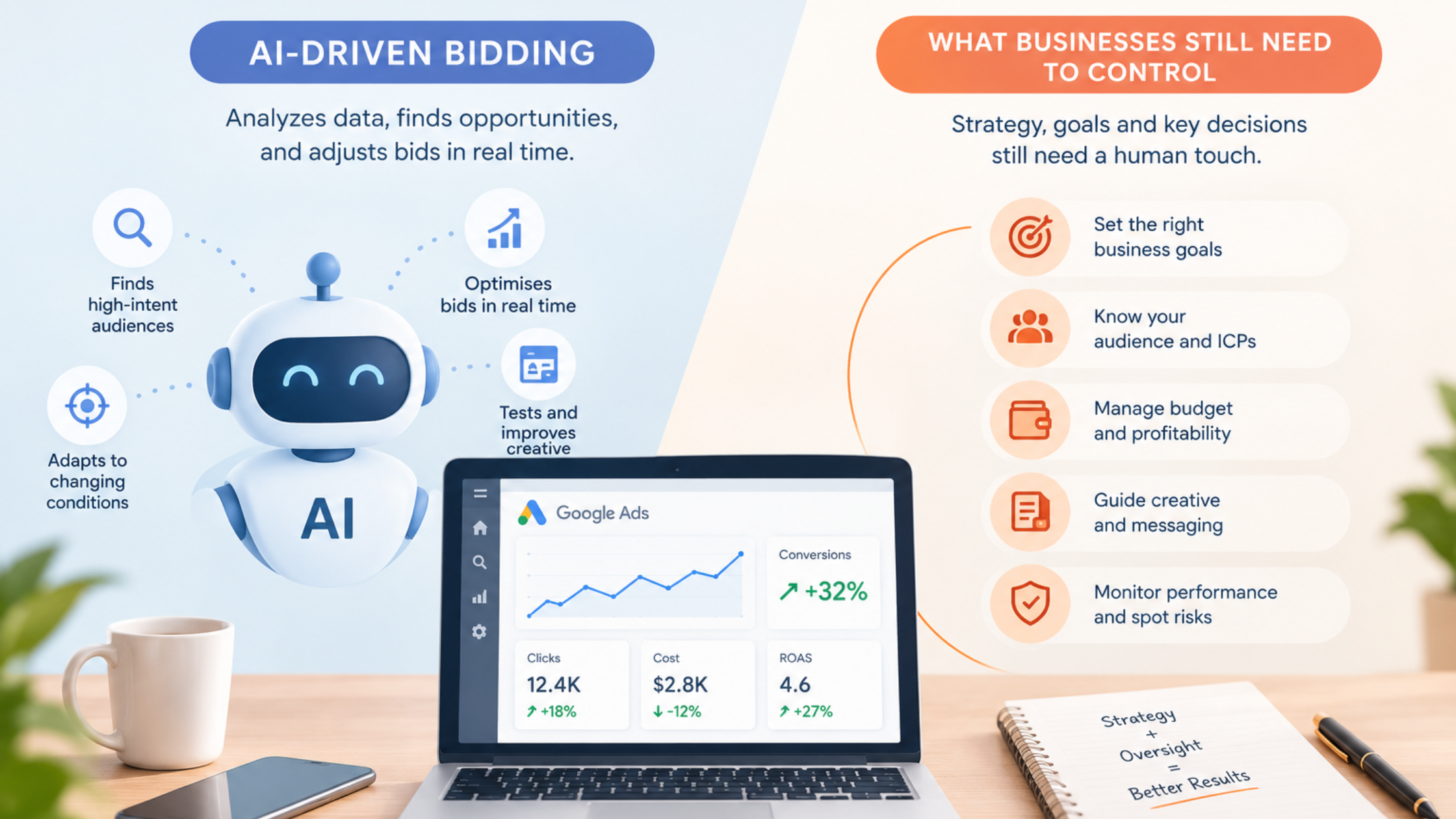
This ongoing process matters because automation is not a substitute for understanding the audience, the offer and what constitutes a valuable lead.
How to prepare your campaigns for the transition
A structured preparation process can help advertisers reduce surprises and make more informed decisions.
1. Audit existing DSA campaigns
Start by identifying campaigns and ad groups that currently use Dynamic Search Ads.
Advertisers currently running google dynamic search ads should pay particular attention to their existing targeting rules, search term relevance and landing page performance before upgrading.
Review their performance, targeting rules, landing pages and conversion history. Note which campaigns consistently generate relevant leads and which already struggle with search relevance or conversion quality.
This provides a baseline against which future performance can be assessed.
2. Review the upgrade settings
Google’s upgrade process converts dynamic ad groups into standard ad groups and existing Dynamic Search Ads into Responsive Search Ads. Text customisation is used to generate the minimum required static assets, while Final URL expansion can be enabled to extend landing page selection.
Understanding the upgrade from dynamic search ads to ai max is particularly important for campaigns that depend on specific URL targeting rules or carefully controlled ad messaging.
Some legacy DSA target rules may become read-only after upgrading, so review existing URL rules and exclusions before proceeding.
Check the available settings carefully, particularly if campaigns depend on specific landing pages or tightly controlled ad messaging.
Refer to Google’s AI Max setup and upgrade guidance for the current process and limitations.
3. Check conversion tracking
Before evaluating the new setup, make sure conversion tracking reflects meaningful actions.
For lead-generation campaigns, a form submission is not necessarily a qualified enquiry. Where possible, connect advertising measurement to downstream outcomes, such as qualified leads, sales opportunities or completed sales.
At a minimum, confirm that conversion actions are configured correctly, duplicate conversions are avoided and the metrics used for bidding reflect the campaign’s real objectives.
Without reliable measurement, it becomes difficult to distinguish genuine improvements from an increase in low-quality activity.
4. Establish a search term review routine
Search term monitoring should remain a regular part of campaign management after the transition.
Review the available search terms and look for patterns, not just isolated queries. Repeated irrelevant searches may indicate that targeting needs refinement or that exclusions should be added.
Where useful, review landing page and asset reporting as well. These reports can help identify whether the pages and messages being selected are contributing to useful outcomes.
Google’s AI Max reporting guidance outlines the reporting options available for evaluating campaign performance.
5. Measure performance against business outcomes
Compare performance using metrics that reflect campaign value, including:
- Cost per conversion: Is the campaign generating enquiries at an acceptable cost?
- Lead quality: Are the enquiries relevant and commercially worthwhile?
- Conversion rate: Are visitors taking the intended action?
- Qualified lead or sales outcomes: Is paid traffic contributing to the pipeline?
- Search relevance: Are the queries and landing pages aligned with the advertised offer?
Allow for normal performance variation and avoid making major decisions based on a small sample of conversions. Where possible, compare results over comparable periods and account for changes in budget, seasonality and other campaign settings.
AI Max works best with active management
AI Max can expand the opportunities available to Search campaigns, but it does not remove the need for sound campaign management.
For businesses researching what is google ai max and how it affects their campaigns, the key consideration is how its automation supports existing advertising goals and lead quality.
The most effective approach is to combine automation with clear controls and regular review. That means maintaining accurate conversion tracking, monitoring search terms, applying negative keywords where needed and checking that landing pages and ad messaging reflect the business accurately.
For agencies managing campaigns across multiple clients, this process is particularly important. Each client may have different definitions of a qualified lead, different restrictions on messaging and different levels of tolerance for broader targeting.
A consistent review process helps teams identify issues early, explain performance changes and make decisions based on evidence rather than assumptions.
This reflects the importance of a broader digital marketing approach that connects campaign performance, website experience and ongoing optimisation.
The takeaway
Google’s move from DSA to AI Max is an opportunity to rethink how Search campaigns discover demand and respond to customer intent. With automatic DSA upgrades scheduled to begin in February 2027, advertisers have time to review their campaigns and plan their next steps.
The priority should be to prepare early, understand the new controls and establish a reliable performance baseline.
Most importantly, judge AI Max by the quality and value of the results it delivers, not simply by how many additional searches, clicks or conversions it generates. Automation can broaden reach, but accurate measurement and ongoing optimisation remain essential to making that reach worthwhile.
Related Articles


Why Choose Us?
With decades of experience and a dedicated team, we are committed to delivering high-quality web development services. Our client-centric approach ensures that we understand your needs and provide solutions that exceed your expectations.