


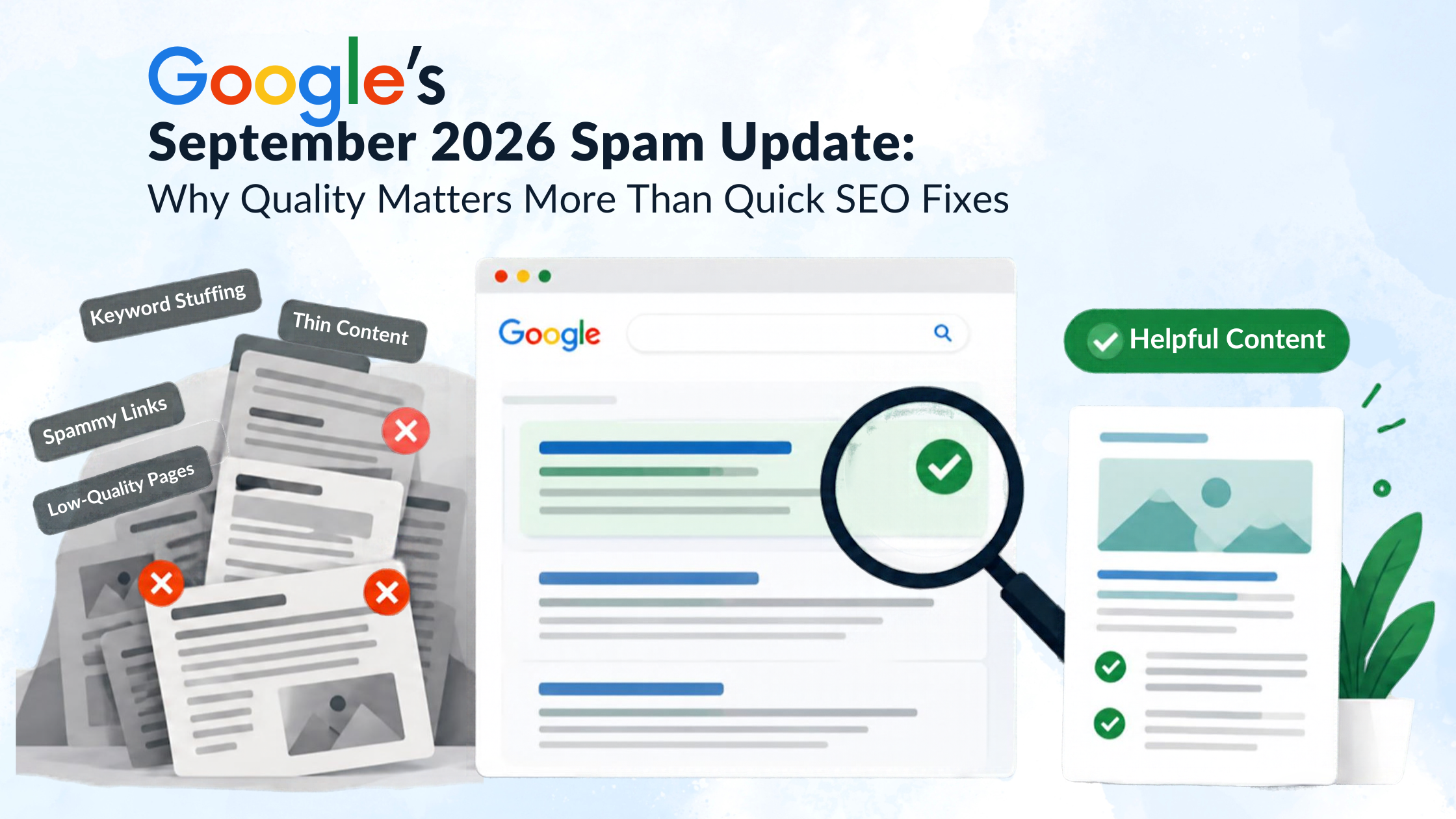
Google’s September 2026 Spam Update: Why Quality Matters More Than Quick SEO Fixes

Google’s latest spam update is a timely reminder for businesses and digital agencies: sustainable search visibility comes from providing genuine value, not finding shortcuts to higher rankings.
The September 2026 spam update began rolling out on 24 September and was completed on 8 October, according to Google’s Search Status Dashboard. The update applies globally and across all languages. Google confirmed the rollout and its completion here.
For businesses that rely on organic search to attract customers, changes like these can raise understandable concerns. Rankings may fluctuate, organic traffic may change, and previously reliable pages may perform differently.
However, a change in performance does not automatically mean a website has been penalised. The priority is to understand what has happened, investigate the evidence and make improvements based on actual performance data.
What is Google’s September 2026 spam update?
Google regularly improves its systems for identifying search spam. These systems aim to prevent websites from manipulating search results through practices that undermine the quality and usefulness of information presented to users.
According to Google’s spam update documentation, changes to its automated spam-prevention systems can affect how websites perform in search results.
Google’s spam policies cover practices such as keyword stuffing, link spam, cloaking and scaled content abuse. These approaches attempt to manipulate search visibility rather than provide a genuinely useful experience for visitors.
For example, a website might publish dozens of near-identical location pages, repeat a target keyword unnaturally throughout its content, or acquire links primarily to influence rankings.
The important distinction is that Search Engine Optimisation itself is not the problem. Helping search engines understand useful content is a legitimate part of digital marketing. The risk comes from tactics designed to manipulate rankings without delivering corresponding value to the people searching.
Google has not stated that every website will be affected by this update. Businesses should therefore assess their own performance rather than assume that any ranking movement is directly attributable to the rollout.
What could the update mean for businesses?
The practical impact of a spam update depends on a website’s existing content, linking practices and overall SEO approach.
Businesses may notice changes in organic clicks, impressions, keyword rankings or the visibility of individual pages. Some may see little noticeable movement, while others may need to investigate significant changes.
There are three areas worth reviewing.
1. Content that prioritises keywords over usefulness
Targeting relevant search terms is a normal part of SEO. Problems arise when keywords become the primary purpose of a page rather than a way to help the right audience find useful information.
Consider a service page that repeats the same phrase throughout multiple headings and paragraphs but provides little detail about the service, who it helps or what a customer can expect.
Even if the page targets a relevant keyword, it offers limited value to the person reading it.
Businesses should review whether their content answers real questions, explains services clearly and provides information that helps visitors make decisions.
That may mean removing repetitive wording, combining overlapping pages or updating articles that no longer reflect current information.
2. Content produced at scale without sufficient value
Publishing regularly can support an effective content strategy, but volume alone does not guarantee results.
Google’s spam policies explicitly address scaled content abuse: producing large amounts of unoriginal or low-value content primarily to manipulate search rankings.
This includes content generated using AI when it is published at scale without adding meaningful value. AI-assisted content is not automatically spam; the concern is the purpose, quality and usefulness of the material.
Businesses should examine whether their content genuinely contributes something to the conversation. Does it include relevant expertise, practical guidance, accurate information or useful answers that readers cannot easily get from a generic page? Whether you are optimising for traditional search engines or preparing for Generative Engine Optimisation (GEO) and Answer Engine Optimisation (AEO), value remains paramount.
If several articles cover essentially the same topic, it may be more effective to consolidate them into one comprehensive resource than continue publishing similar material.
3. Backlinks that exist primarily to manipulate rankings
Links from relevant, reputable websites can help people discover a business and provide useful context about its online presence. However, acquiring links primarily to manipulate search rankings creates risk.
Google identifies practices such as buying links for ranking purposes, automated link creation and excessive link exchanges as examples of link spam.
Businesses should review their link-building approach and assess whether their efforts focus on relevant relationships, useful resources and legitimate industry recognition.
It is also important not to assume that every unfamiliar or low-quality-looking backlink is harmful. A website may attract links without requesting them. Reviews should focus on credible evidence of manipulative practices rather than treating every questionable link as a reason for immediate action.
How to monitor performance after the update
When search visibility changes, the first step should be measurement, not immediate action.
Google Search Console provides useful information about how a website appears in Google Search, including clicks, impressions, click-through rates and average positions.
A structured review can help separate meaningful changes from normal fluctuations.
Start with these steps:
Compare performance before and after the rollout. Review comparable periods and allow for normal variations in demand, seasonality and search behaviour.
Identify the affected pages. Determine whether changes are concentrated in particular service pages, blog articles, categories or sections of the website.
Review the search queries involved. Look at which terms have lost impressions, clicks or visibility. This can help establish whether the change affects a specific topic or a broader part of the site.
Check for other technical or operational issues. Investigate indexing problems, accidental noindex directives, robots.txt changes, broken pages, recent website releases and other factors through regular technical website maintenance.
Record your findings before making changes. Establish a baseline and document what you discover. This makes it easier to understand whether subsequent improvements have helped.
It is also worth checking whether competitors have improved their content, whether search intent has changed or whether the search results themselves now display different types of pages.
A decline in organic traffic can have several causes. The timing of a Google update is a reason to investigate, not proof of causation.
Why businesses should avoid rushed SEO changes
One of the most common mistakes after a significant ranking change is making multiple SEO adjustments before understanding the problem.
A business might rewrite its key landing pages, remove large amounts of content, change internal links and launch a new link-building campaign within a few days.
If performance subsequently improves or declines, it becomes difficult to determine which changes made a difference.
A more measured approach is to identify the strongest evidence, prioritise the most relevant issues and implement changes in a controlled way.
Where content is genuinely outdated or unhelpful, improving it is worthwhile regardless of the update. Where there is evidence of spam-related practices, address those practices directly.
Google also notes that recovery following spam-related changes may take time as its systems reassess a website. For link spam specifically, removing the effect of manipulative links does not necessarily restore any ranking benefit those links previously generated. This is another reason to focus on sound organic search optimisation practices rather than expect an immediate return to previous rankings.
This is another reason to focus on sound SEO practices rather than expect an immediate return to previous rankings.
Building a more resilient SEO strategy
The September 2026 spam update reinforces the value of an SEO strategy built around consistent improvement.
For businesses and the agencies supporting them, this means treating content quality, technical health, website performance optimisation, and performance monitoring as ongoing responsibilities rather than tasks to revisit only when rankings fall.
A practical review should include:
Content quality: Check that important pages are accurate, useful, clearly written and aligned with what visitors need.
Content maintenance: Update outdated information and consolidate overlapping pages where doing so improves the user experience.
Technical SEO: Monitor indexing, crawlability, page accessibility and changes introduced through website updates.
Core web architecture: Ensure your foundation relies on modern business website development and scalable enterprise web development standards that provide seamless user experiences.
Link quality: Focus on relevant, legitimate links rather than schemes intended to manufacture ranking signals.
Performance reporting: Track clicks, impressions, rankings and organic conversions so that changes are assessed against meaningful business outcomes.
For agencies, a consistent review process is particularly valuable when managing several websites. Clear reporting, documented investigations and prioritised recommendations help clients understand what has changed and why a particular response is appropriate.
The goal is not to eliminate every ranking fluctuation. Search results change, competitors improve and customer behaviour evolves. The goal is to build websites that can respond to those changes without relying on manipulative tactics or constant reactive adjustments.
The takeaway: Focus on evidence, not panic
Google’s September 2026 spam update is a useful prompt to review how a website earns its search visibility.
If rankings or organic traffic have changed, begin by checking Google Search Console, identifying affected pages and investigating possible causes. Review content and backlink practices where the evidence suggests an issue, and avoid making widespread changes simply because an update has occurred.
Most importantly, make quality an ongoing priority. Useful content, technically sound websites and responsible SEO practices provide a stronger foundation than shortcuts designed to produce temporary ranking gains.
Sustainable SEO is not about chasing every algorithm update. It is about understanding performance, improving what matters and consistently helping people find the information they need.
Related Articles





Why Choose Us?
With decades of experience and a dedicated team, we are committed to delivering high-quality web development services. Our client-centric approach ensures that we understand your needs and provide solutions that exceed your expectations.