


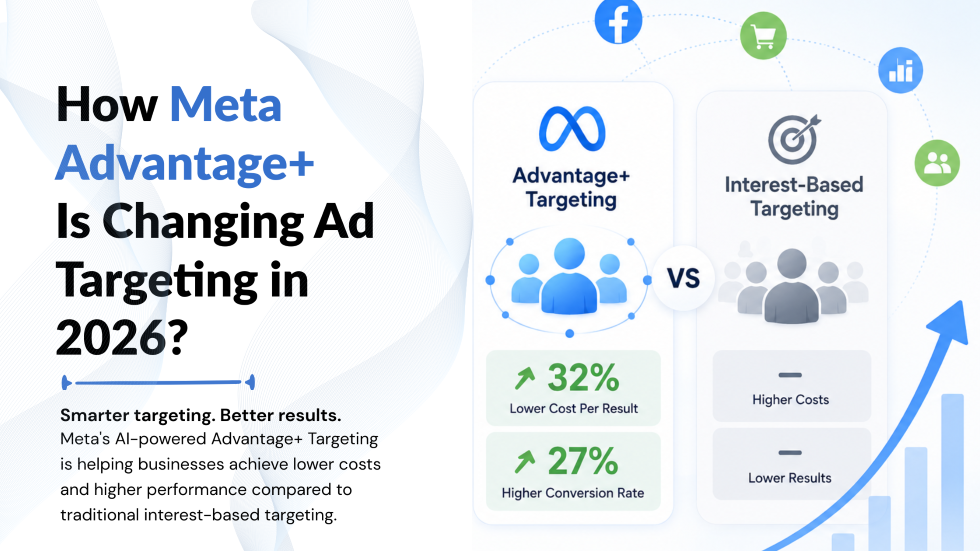

For years, Meta advertisers treated the audience targeting a craft.
The process was manual and deliberate: layer interests, narrow demographics, apply exclusions, and build carefully segmented audiences designed to find the “right” customer.
That approach worked well — until it didn’t.
In 2026, Meta’s advertising platform looks very different. AI and machine learning now sit at the centre of campaign delivery, and the platform increasingly rewards advertisers who give its algorithm room to work.
That is why Advantage+ targeting has become Meta’s recommended default — and why many brands still relying on traditional interest targeting are seeing diminishing returns.
The shift is not about removing control for the sake of automation. It is about recognising that Meta now has more behavioural data, stronger predictive models, and faster optimisation capabilities than any human media buyer can replicate manually.
The old logic behind interest targeting
Interest targeting made an intuitive sense.
If you sell running shoes, target people interested in running.
If you sell business software, target small business owners.
Simple.
The problem is that consumer behaviour rarely follows neat categories.
Someone may never explicitly signal interest in “running” but still buy new shoes every six months.
Another person may follow dozens of fitness pages and never purchase anything.
Interest targeting relies on static assumptions. It asks advertisers to predict who will convert before Meta has a chance to analyse real intent.
That used to be necessary.
It is much less useful now.
How does Advantage+ change the game?
Meta’s Meta Advantage+ works differently.
Instead of forcing advertisers to define a narrow audience, it uses broad signals and machine learning to determine who is most likely to take the desired action — whether that is a purchase, lead submission, or app to install.
That includes signals advertisers cannot manually access, such as:
- recent browsing and engagement patterns
- device-level behavioural indicators
- content interaction history
- purchase probability modelling
- real-time auction behaviour
In practical terms, that means Meta is no longer asking, “Who do you think your audience is?”
It is asking, “What outcome do you want?”
Then it works backwards.
That distinction matters.
Meta’s own benchmarks and independent industry reporting suggest Advantage+ campaigns can reduce CPA by as much as 20–30% in many ecommerce and lead-generation environments when compared with traditional manual targeting.
Why did privacy change accelerate this shift?
A major reason for this change is privacy.
Since Apple App Tracking Transparency was introduced, advertisers have faced significant signal loss from iOS devices.
That means:
- fewer tracked conversions
- weaker retargeting pools
- less reliable audience data
Some industry estimates suggest advertisers lost around 40% of observable user signals on Apple devices after ATT changes.
That made detailed targeting less reliable.
When the available data becomes less precise, relying on rigid interest categories becomes riskier.
Broad targeting paired with stronger algorithmic prediction became the better option.
Meta adapted accordingly.
Interest targeting now acts more like a suggestion
Another major change: in many campaign types, Meta now treats detailed targeting inputs as suggestions, not hard rules.
That means even when advertisers choose specific interests, Meta often expands beyond them if it predicts better results.
In other words, the platform is already overriding manual targeting in many cases.
Many advertisers do not realise this.
They believe they are tightly controlling audience selection when Meta is quietly broadening delivery in the background.
That alone shows where the platform is heading.
Why do advertisers still resist broad targeting?
The biggest reason is psychological. Manual targeting feels safer. It feels more strategic. It gives the impression of control. You can point to an audience and say, “That is exactly who I am targeting.”
On the other hand, advantage+ removes some of that visibility. You trust the algorithm more than your own assumptions. That can feel uncomfortable — especially for experienced media buyers trained in older Meta workflows. But performance marketing is not about comfort. It is about the results. And increasingly, the results favour broader, AI-driven delivery.
Where do advertisers go wrong with Advantage+?
Advantage+ is powerful, but it is not magic. It does not fix weak strategy, and it amplifies good inputs — and bad ones.
Three things still matter enormously:
- Strong creative
In a broad targeting environment, creativity becomes a major targeting signal. Your ad itself tells Meta who should see it. Weak creative gives the algorithm poor feedback. Strong creative sharpens optimisation.
- Accurate conversion tracking
Without reliable data, Meta cannot be learned effectively. That means properly configured:
- event prioritisation
- clean attribution setup
- Enough conversion volume
Meta’s system needs data. Accounts generating only a handful of conversions per week often struggle because the algorithm lacks enough learning signals. That is one reason narrow manual audiences can sometimes still help smaller advertisers.
A common testing mistake
A frequent mistake is comparing Advantage+ against a very small, tightly defined interest audience on a tiny budget. That is not a fair test. Broad AI systems need room to optimise. If you only spend $20 a day for five days, Meta has barely started learning.
The better test is:
- broader audience
- larger budget
- longer learning window
- consistent creative
That is where Advantage+ usually wins.
A practical example
Consider an ecommerce brand using traditional interest targeting.
Their campaigns were producing traffic, but conversion rates had plateaued, and acquisition costs kept rising.
They switched to Advantage+.
Nothing else changed:
- same product
- same creative
Within weeks, Meta began finding users outside their original interest groups who converted at a lower cost.
Results improved because the algorithm was identifying intent they had not considered.
That is the core advantage.
Not broader reach for its own sake.
Smarter reaches.
Does interest targeting still have a place?
Yes — just a smaller one.
Interest targeting still makes sense when:
- launching a brand-new account with no data
- testing niche markets
- running highly local campaigns
- validating new creative angles
But it is increasingly a testing tool, not a scaling strategy. That is an important distinction.
The takeaway
Meta has spent the last several years teaching advertisers a new lesson:
Stop telling the algorithm exactly who to target. Start telling it what success looks like.
That is the real shift behind Advantage+.
The advertisers performing best in 2026 are not the ones building the cleverest interest stacks.
They are the ones feeding Meta:
- better creative
- cleaner conversion data
- clearer business and marketing goals
And then letting the machine do what it was designed to do.
For most brands, that means broad, AI-led targeting is no longer an experiment. It is the default.
Related Articles

Why Choose Us?
With decades of experience and a dedicated team, we are committed to delivering high-quality web development services. Our client-centric approach ensures that we understand your needs and provide solutions that exceed your expectations.