


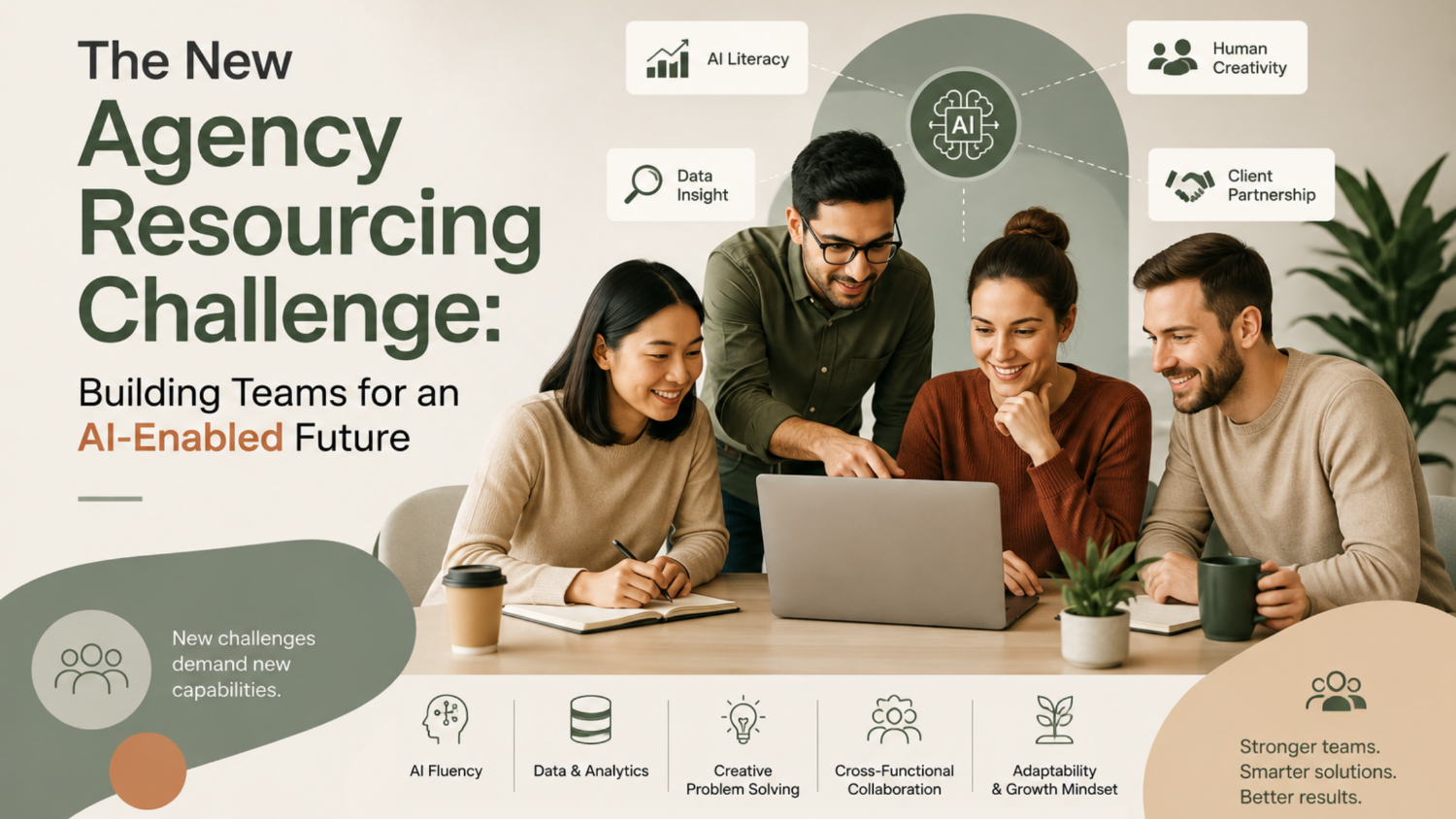

For digital agencies, finding the right people has never been straightforward.
Specialist skills can be hard to find, expensive to hire and even harder to retain. In Sonnet’s agency survey, areas including web development, SEO and data analytics stood out as particular resourcing challenges, with scarcity and cost making it difficult for agencies to build every capability they need in-house.
For agencies that need to extend their delivery capabilities without building every specialist function internally, custom web development services can provide a flexible way to access additional technical expertise when required.
Now AI has added another layer of complexity.
On one hand, agencies are hearing that AI will dramatically improve productivity and reduce their reliance on people. On the other, the experience inside many agencies is more nuanced. AI can save significant amounts of time, but the quality is not always there without experienced people guiding, reviewing and improving the work.
This is at the heart of the wider conversation around AI in the workforce: the technology is changing how people work, rather than simply removing the need for people altogether.
That leaves agency leaders with a difficult question: how do you make resourcing decisions today when you don’t yet know what your ideal team will look like in two or three years?
The answer probably isn’t to replace people as quickly as possible. Nor is it to build an operating model around whichever AI platform happens to be attracting the most attention this month.
The more sensible approach is to build for adaptability.
AI is changing the work, not simply removing it
There is plenty of evidence that AI is becoming part of agency operations. Forrester reported in 2026 that nine in 10 US marketing agencies use generative AI, while improving staff productivity and impact was the primary objective for 81% of agencies using it.
That matters. Agencies operate in a business where efficiency directly affects margins, capacity and competitiveness. If AI can reduce the time required for repetitive tasks, speed up research, assist with development or help teams produce an initial draft, it would be strange not to explore those opportunities.
But productivity gains are not the same as replacing expertise.
At Sonnet, there are clear areas where AI can improve efficiency across digital delivery. It can help people get started faster, reduce manual work and accelerate parts of a process.
The challenge is consistency.
An AI-generated output can look convincing without being quite right. It might miss important context, misunderstand the brief, introduce errors or produce something technically functional but strategically weak. In these situations, the value comes not just from the tool, but from the person who knows what a good result should look like.
This is one reason the idea of an ai enabled workforce is becoming more useful than the idea of an AI-only workforce: people and technology can complement each other when the right expertise remains in the process.
That is why the conversation about AI and agency resourcing needs to move beyond a simple question of people versus technology.
The more useful question is: which work can technology improve, and what level of human expertise is needed around it?
AI may reduce the amount of time a task takes. It does not automatically remove the need for someone capable of judging whether the result is good.
The same principle applies to ongoing digital delivery, where website maintenance services still rely on people to identify issues, assess priorities and make informed decisions about website performance and improvements.
Behind the AI success stories, there is still a lot of experimentation
If you spend enough time on LinkedIn, it can appear that every agency has already worked out its AI strategy.
There are impressive case studies, dramatic productivity claims and plenty of confident predictions about what agency teams will look like in the future.
Behind the scenes, however, many agencies are still experimenting.
They are working through some fairly fundamental questions:
- What should we use AI for?
- Where should we avoid using it?
- Which tools are worth investing in?
- How should people work alongside AI?
- What controls are needed around quality, data and client work?
- Which skills will matter more as AI becomes part of everyday delivery?
- What does all of this mean for future hiring?
That uncertainty is understandable. Agency-specific research published in 2026 found that the impact of AI remained uneven, with many agencies still experimenting and working out where the technology was delivering genuine value.
More broadly, the pace of skills change is substantial. LinkedIn has estimated that 70% of the skills used in most jobs could change by 2030, with AI acting as a major catalyst. AI literacy is also among the fastest-growing skills across regions and job functions.
For agency leaders asking “how is ai affecting jobs?”, the answer is increasingly less about a simple reduction in headcount and more about how responsibilities, workflows and required skills are evolving.
So the uncertainty is not necessarily a sign that an agency is falling behind. In many cases, it reflects the reality that the technology itself is still moving quickly.
This is very much a watch this space environment.
Don’t build your entire operating model around today’s tools
One of the biggest risks for agencies is overcommitting too early.
AI platforms, models and capabilities are changing rapidly. A workflow that feels highly efficient today may be replaced by a better tool in six months. A feature that requires a specialist platform now may become standard functionality elsewhere.
That doesn’t mean agencies should sit on the sidelines.
Quite the opposite. Agencies should experiment, identify useful applications and look seriously for efficiencies. But there is a difference between learning how to use AI and redesigning an entire business around one specific tool or process.
The more durable investment is in the organisation’s ability to adapt.
As AI in the workforce continues to evolve, adaptability may prove more valuable than trying to predict exactly which platforms, roles or processes will dominate several years from now.
The World Economic Forum’s Future of Jobs Report 2025 points in a similar direction: AI and big data are among the fastest-growing skills, but analytical thinking, resilience, flexibility, creative thinking and lifelong learning also remain increasingly important. The report identifies skills gaps as a major barrier to business transformation.
For agencies, that suggests future-proofing is unlikely to mean hiring one particular type of “AI person” and considering the job done.
It is more likely to mean building teams that combine technical capability with judgement, curiosity and the ability to learn new ways of working.
Put guardrails around AI, then let people experiment
A useful AI strategy does not have to be entirely top-down.
In fact, the people doing the work often spot practical opportunities faster than a leadership team designing workflows from a distance. A developer may discover where AI genuinely speeds up coding or testing. An SEO specialist may identify useful research or analysis tasks. A project manager may find ways to reduce administrative work.
For example, an SEO specialist might use AI to accelerate research while relying on established SEO services expertise to interpret findings, assess search intent and decide what recommendations are actually worth implementing.
The key is to create enough structure for experimentation to happen safely.
That might include clear guidance around:
- approved and unapproved tools
- confidential or client information
- when human review is mandatory
- quality assurance and accountability
- documenting useful workflows
- testing before new processes are widely adopted
Within those boundaries, give people room to try things.
This creates a more practical feedback loop. Rather than investing heavily in a theoretical AI strategy, agencies can learn from real work: what saves time, what improves quality, what creates new risks and what simply adds another layer of complexity.
The result is an operating model based on evidence rather than hype.
The definition of a valuable digital employee is changing
AI is also beginning to influence hiring.
Through Sonnet’s sister company, Parallel, there is growing demand for hiring Philippine’s based talent who are already comfortable working with AI tools. At the same time, entirely new requirements are emerging around areas such as AEO and GEO.
This does not necessarily mean agencies will need fewer people.
It means the definition of a valuable digital employee is changing.
Technical expertise will still matter, but knowing how to work effectively with AI is becoming part of the broader capability mix. The most valuable people may increasingly be those who can combine strong domain knowledge with the ability to use AI efficiently and, crucially, judge its output.
In an ai enabled workforce, that combination of specialist knowledge, AI fluency and human judgement can become a significant competitive advantage.
Recent LinkedIn data points to the same shift. Its 2026 labour market research found strong growth in jobs requiring AI literacy, while also describing the emergence of AI-enabled roles that blend technical knowledge with distinctly human strengths.
For agencies, hiring may therefore become less about finding a perfect match for a fixed job description and more about assessing whether someone can continue developing as the work changes.
That has implications for both recruitment and retention.
Instead of assuming the answer to every new capability requirement is another specialist hire, agencies may need to think more carefully about how existing people can be trained, supported and redeployed.
Build flexibility into the resourcing model
The traditional agency challenge was largely about finding enough of the right specialists at the right time.
That challenge has not disappeared. If anything, AI makes the planning problem more complicated because it may change both the volume of work people do and the skills required to do it well.
A more useful way to think about how is ai affecting jobs is to consider which responsibilities will change, which new capabilities will emerge and where human expertise will remain essential.
A sensible response is to build flexibility into the resourcing model.
That could mean maintaining a strong core of experienced people while avoiding unnecessary rigidity around team structures. It could mean investing more in training and internal knowledge sharing. It could also mean using trusted delivery partners to access specialist capability without assuming every skill needs to exist permanently inside the agency.
This approach can also make additional web development services a useful part of an agency’s wider resourcing model, particularly when specialist development expertise is needed for a specific project or period of increased demand.
The goal is not to predict the exact shape of the agency workforce in 2029.
At this point, that would require more confidence than the technology warrants.
The goal is to make sure the agency can adapt when the picture becomes clearer.
The practical takeaway
The smartest response to AI is neither fear nor blind enthusiasm.
Agencies should experiment. They should look for genuine efficiencies. They should encourage people to become more capable with AI and pay attention to emerging skills.
But they should also be cautious about assuming today’s tools or workflows represent the final destination.
For now, the strongest resourcing model is likely to combine three things:
- Experienced people who bring judgement and domain expertise.
- AI-enabled skills that help those people work more efficiently.
- Enough flexibility to change as the technology and the market evolve.
AI may change how much resource agencies need and what that resource looks like. Some tasks will take less time. Some roles will evolve. New specialties will emerge.
Ultimately, the future of AI in the workforce is likely to favour agencies that can combine technology with adaptable people, rather than those that simply pursue automation for its own sake.
What AI has not removed is the need for experienced people who can understand the problem, use the right tools and take responsibility for the quality of the result.
For agency leaders, that may be the most important thing to remember while the future is still taking shape: don’t try to lock in the perfect AI-era team too early. Build a team and resourcing model that can keep learning.
Related Articles

Why Choose Us?
With decades of experience and a dedicated team, we are committed to delivering high-quality web development services. Our client-centric approach ensures that we understand your needs and provide solutions that exceed your expectations.