


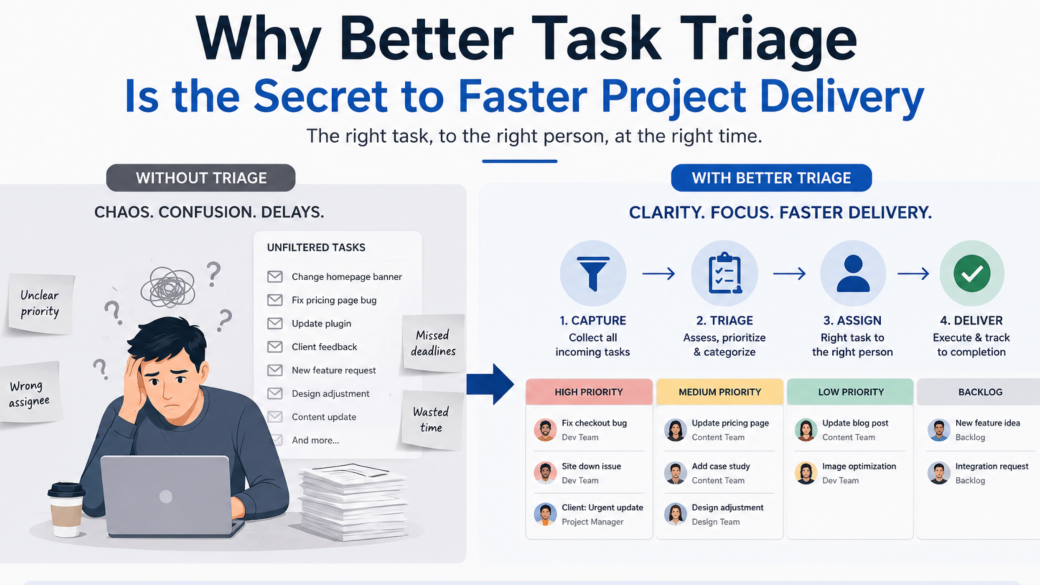

In every agency, speed matters. Clients expect quick responses, efficient delivery and projects that move smoothly from request to completion.
Yet many delays aren’t caused by technical complexity or limited resources. They’re caused by something much simpler: incomplete task information.
It’s common for client-facing team members to receive a request and simply copy and paste it into a project management tool like Asana before assigning it to the delivery team. While this might seem like the fastest approach, it often creates more work than it saves.
A few extra minutes spent performing a proper triage can eliminate hours—or even days—of unnecessary back-and-forth.
Strong task triage is one of the simplest ways to improve operational efficiency because it reduces delays before work even begins.
What is task triage?
Task triage is the process of reviewing a client’s request before it reaches the delivery team.
Rather than acting as a messenger, the person communicating with the client becomes an interpreter. Their role is to understand what the client actually needs, identify any missing information and ensure the task contains everything required before work begins.
Think of it like a doctor assessing a patient before treatment. The diagnosis comes first because the quality of the diagnosis determines the effectiveness of the treatment.
Projects work exactly the same way.
The same principle applies to Corporate Website Development, where well-defined requirements at the beginning lead to smoother delivery and fewer revisions later.
The hidden cost of skipping triage
When tasks are created with minimal information, delivery teams immediately run into questions.
- Which website is this for?
- Do we have access to the platform?
- Has the client supplied the required assets?
- Is there approved copy?
- Are there brand guidelines?
- What does success actually look like?
Each missing answer creates another interruption.
The task stops.
Someone has to contact the client.
The client replies hours later—or sometimes days later.
The task resumes only to uncover another missing piece.
What looked like a five-minute task can quickly stretch into several days simply because the right questions weren’t asked at the beginning.
Research from the Project Management Institute (PMI) consistently shows that poor communication is one of the leading contributors to project failure and rework. Likewise, studies by McKinsey have found that improving communication and collaboration can significantly increase productivity across knowledge-based work.
The lesson is simple: clearer inputs create faster outputs.
For agencies exploring how to improve project delivery efficiency, strengthening the quality of task information before work begins is one of the highest-impact improvements they can make.
What good triage looks like
Effective triage isn’t about making the task description longer.
It’s about making it complete.
Before assigning work, the client-facing team member should ask themselves:
- What is the client trying to achieve?
- What information is missing?
- What credentials or system access will the team need?
- Are all required assets available?
- Is there approved content or copy?
- Are there deadlines or dependencies?
- Has the client confirmed exactly what they expect?
Only once these questions have been answered should the task be assigned.
The delivery team can then begin work immediately instead of becoming investigators.
This proactive approach strengthens project management by ensuring tasks are actionable before they ever reach the delivery team.
Clarify first, assign second
One of the most valuable habits a client-facing team member can develop is confirming their understanding before creating the task.
Instead of immediately saying:
“I’ll pass this to the team.”
They should respond with something like:
“Just to confirm, you’d like us to update the homepage banner with the new campaign artwork, replace the call-to-action button, and schedule the changes for Friday afternoon. We’ll need the final artwork and approved copy before we begin. Is that correct?”
This simple summary gives the client an opportunity to correct misunderstandings before work starts.
It prevents assumptions from becoming mistakes.
More importantly, it ensures everyone is working towards the same outcome.
AI can copy. People should think.
With modern AI tools, copying and pasting client requests into a project management system is becoming increasingly easy.
That’s precisely why human value is shifting elsewhere.
The role of client-facing staff isn’t simply to transfer information.
It’s to interpret, clarify and organise it.
AI can help draft tasks or summarise conversations, but it can’t always identify missing credentials, spot conflicting requirements or ask the follow-up questions that only an experienced project coordinator knows to ask.
The real value lies in understanding the work—not merely documenting it.
This is especially important for Custom web development services, where clarifying requirements early reduces ambiguity and allows delivery teams to focus on execution rather than gathering missing information.
When combined with effective project management practices, AI becomes a powerful assistant rather than a replacement for critical thinking.
Better triage creates better delivery
The benefits of effective triage extend across the entire project lifecycle.
Teams experience:
- fewer clarification requests
- fewer stalled tasks
- less rework
- faster completion times
- improved client confidence
- smoother project management.
Instead of constantly switching between tasks while waiting for missing information, delivery specialists can stay focused on producing quality work.
Clients also notice the difference.
Rather than receiving repeated requests for missing details, they’re asked the right questions once, at the beginning.
That creates confidence in the process and reinforces professionalism.
Over time, these improvements contribute to greater operational efficiency, allowing agencies to deliver more work without creating unnecessary bottlenecks.
A small change with a big impact
Task triage isn’t an additional administrative step.
It’s an investment in delivery efficiency.
Every question answered before work begins is one less interruption later.
Every clarified requirement reduces the chance of rework.
Every complete task helps delivery teams spend more time delivering and less time chasing information.
For agencies looking to improve productivity, the solution isn’t always hiring more people or implementing new software.
Sometimes it’s simply ensuring the work is properly understood before anyone starts.
If you’re wondering how to improve project delivery efficiency, better task triage is one of the most practical and cost-effective places to start.
Because the fastest projects aren’t necessarily the ones worked on the hardest.
They’re the ones that were prepared the best.
Related Articles


Why Choose Us?
With decades of experience and a dedicated team, we are committed to delivering high-quality web development services. Our client-centric approach ensures that we understand your needs and provide solutions that exceed your expectations.