


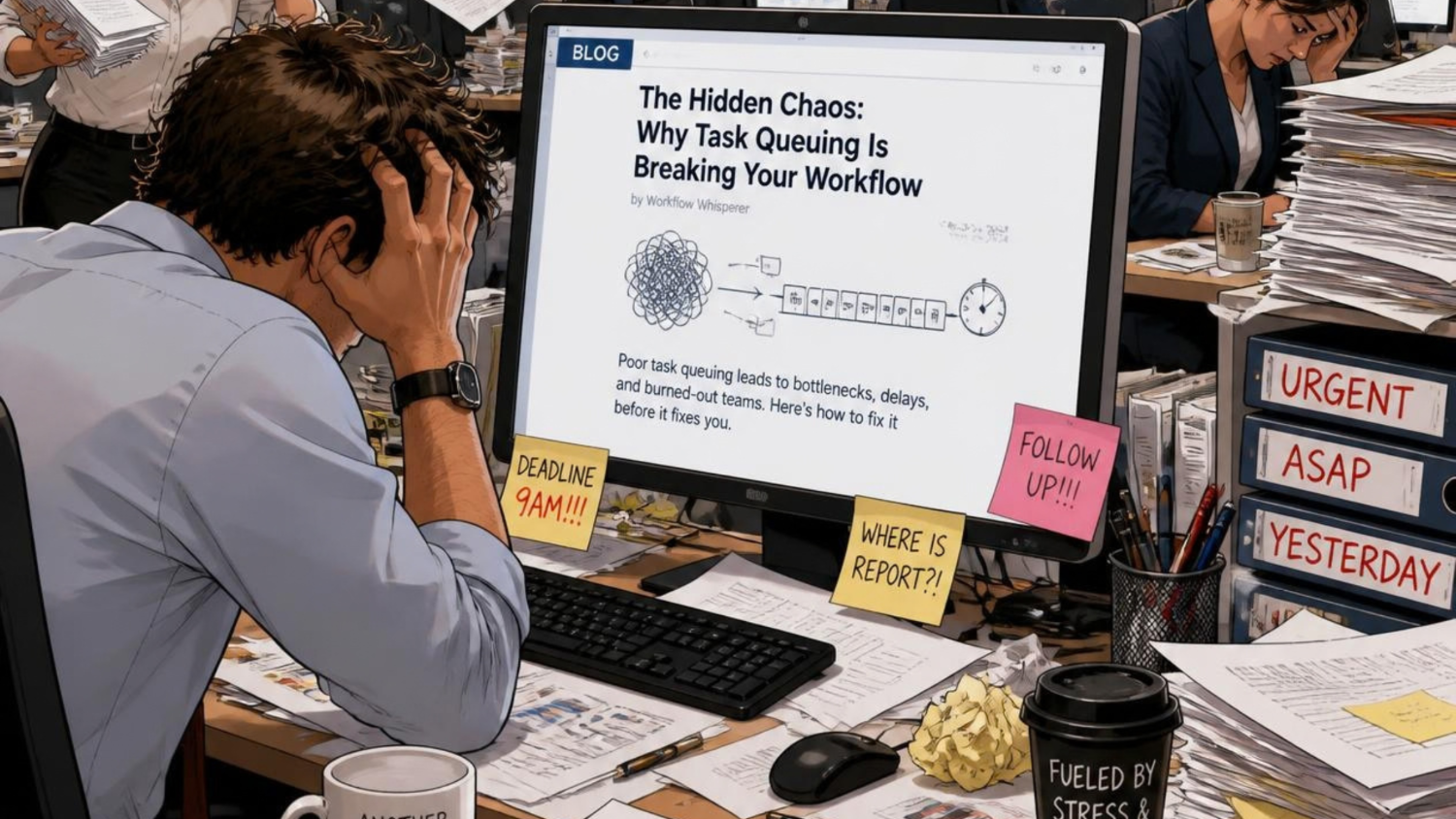

For most agencies, project planning starts with a relatively simple calculation: what needs to be delivered, how many hours are available, and who is responsible for the work.
That plan can look perfectly manageable at the beginning of the week.
Then something changes.
A client sends through a “quick” request. Another stakeholder needs an update. A new task is added directly to a team member’s workload. Something is labelled urgent and needs to be done immediately.
Individually, none of these requests seems particularly disruptive. The problem starts when new work enters the workflow without being properly queued, prioritised or communicated.
This is where effective task prioritisation becomes essential, helping teams assess new requests against existing commitments rather than treating every request as an isolated task.
The original project plan still exists on paper, but the capacity behind it has changed.
And when that happens repeatedly, the impact doesn’t stay with the person who received the new task. It can eventually affect the entire team, including people working on projects that had nothing to do with the original request.
The hidden cost of an “urgent” task
In an agency, resources are rarely sitting completely idle waiting for the next request.
People are typically booked against projects, with their available hours allocated based on expected deliverables and deadlines. That means adding an unplanned task is not simply a matter of finding an empty space in someone’s calendar.
Something else may need to move.
Imagine a developer has six hours allocated to a project on Tuesday. A new client request arrives that is expected to take two hours. The developer completes it because it is considered urgent.
Those two hours have to come from somewhere.
Perhaps the original project now needs to continue on Wednesday. That could push back a designer’s work. The designer’s delay could then affect QA, and QA’s delay could affect the client’s review date.
The original “quick task” may have taken two hours, but the delivery impact can be much larger.
This ripple effect is one of the main challenges of managing competing priorities in a busy agency environment.
This is why task management is not just about assigning work. It is about understanding the effect of new work on the entire delivery system.
This is particularly relevant for recurring client work such as website maintenance services, where new requests need to be balanced against existing delivery commitments.
The problem isn’t urgency. It’s invisible urgency.
Client needs do change. Agencies need to be responsive, and genuinely urgent work will sometimes need to take priority.
The problem is treating every new request as if it can simply be inserted into an existing schedule without changing anything else.
When every task is urgent, the team loses the ability to distinguish between:
- Work that must happen immediately
- Work that needs to happen soon
- Work that can be scheduled
- Work that needs clarification before it can be actioned
Without that distinction, the team is effectively operating with multiple competing priorities.
For teams asking how do you handle competing priorities, the answer usually starts with making those priorities visible and agreeing on clear criteria for what should move first.
This is where a clear task queue becomes important.
A queue provides a shared view of what has arrived, what needs to happen next, who needs to be involved and where the work fits against existing commitments.
It turns an interruption into a decision.
A task queue protects the plan
A useful task queue does not have to be complicated.
At a minimum, every new request should make it possible to answer a few basic questions:
- What is the task?
- Who is responsible for it?
- When is it actually required?
- How much effort is expected?
- What project or client does it relate to?
- What happens to existing work if it is prioritised?
The last question is particularly important.
Adding a task should trigger a capacity conversation, not simply an assignment.
Good agency workflow management makes that capacity conversation part of the process rather than leaving individual team members to absorb unexpected work themselves.
If someone is already fully booked, the decision should be visible: either the new task waits, another task moves, additional capacity is found, or the deadline changes.
This can be especially important when managing ongoing website support, where unexpected fixes and client requests can compete with planned project work.
That makes the trade-off explicit rather than pushing the consequence onto another project.
Don’t let the queue become another source of chaos
A queue only works if it has clear rules.
For example, an agency might structure incoming work around four simple stages:
Requested → Reviewed → Prioritised → Scheduled
New requests first enter the queue rather than going directly to a team member.
Someone with the appropriate oversight then assesses the request against existing commitments. If it genuinely needs immediate attention, the team can decide what needs to move to accommodate it.
Consistent task prioritisation at this stage helps prevent the loudest or most recent request from automatically becoming the team’s highest priority.
This creates a useful separation between requesting work and committing resources to work.
That distinction becomes increasingly important as an agency grows.
Without it, people can unintentionally commit resources they do not control, while project managers discover the consequences only after deadlines start slipping.
The same challenge can apply to specialist work such as SEO services, where technical, content and optimisation tasks may compete for shared agency resources.
Limit the amount of work happening at once
There is another useful principle from Kanban that applies well to agency delivery: limiting work in progress, or WIP.
WIP limits are designed to prevent teams from taking on more active work than they can realistically handle. They make bottlenecks more visible and encourage teams to finish existing work rather than continually starting something new.
The principle is straightforward: starting more work does not necessarily mean getting more work done.
When people constantly switch between projects and tasks, they have to repeatedly rebuild their context. That can reduce focus and contribute to fatigue and errors.
For an agency, this might mean being more deliberate about how many projects or tasks a person can actively work on at one time.
This is another important part of managing competing priorities: reducing unnecessary context switching instead of simply adding more work to an already full schedule.
A new urgent request should therefore prompt a question:
What are we stopping or delaying to make room for this?
That question creates accountability around capacity.
Make delays visible before they become surprises
One of the biggest benefits of a proper queue is that it creates an early warning system.
If the incoming queue is growing faster than the team can process it, that is useful information.
It may indicate:
- The team is at capacity.
- Certain types of work are creating a bottleneck.
- Requests are being submitted too late.
- Priorities are changing too frequently.
- A particular skill set is becoming a constraint.
- Project estimates or available capacity need to be reviewed.
Recurring work such as technical website maintenance can also become a bottleneck when requests arrive faster than the available team capacity.
WIP and flow metrics can help make these problems visible. For example, tracking the number of active tasks, throughput and cycle time can provide a clearer picture of how work is actually moving through the system.
These metrics can strengthen agency workflow management by showing where work is slowing down before missed deadlines become the first visible sign of a problem.
The goal isn’t to create more reporting for the sake of reporting.
It is to spot problems while there is still time to do something about them.
The conversation with clients matters too
Good task queuing also supports better client communication.
If a client asks for something urgently, the answer does not always have to be “no”.
It can be:
“We can prioritise this, but it will move the delivery date for X.”
That is a much more useful conversation than accepting the request immediately and explaining several days later that another deadline has slipped.
Clients can make informed decisions when the consequences are clear.
They may decide the new request is genuinely more important. They may be comfortable with the original project moving. Or they may decide that the new request can wait.
The important thing is that the decision is made consciously.
When clients ask how do you handle competing priorities, being transparent about these trade-offs can be just as important as the internal process used to manage the work.
A better definition of responsiveness
Being responsive does not mean saying yes to everything immediately.
For an agency, responsiveness means having a reliable process for determining what needs attention, when it can be done and what needs to change to accommodate it.
That requires visibility.
When new work is captured in a shared queue, reviewed against existing commitments and prioritised based on clear criteria, teams can respond to clients without constantly destabilising their delivery plans.
The result is not necessarily fewer urgent requests.
It is fewer surprise consequences from those requests.
The practical takeaway
Every agency will have unexpected work. The goal isn’t to eliminate it.
The goal is to stop unexpected work from becoming invisible work.
A simple task-queuing process can help teams:
- Capture every new request in one place.
- Make priorities visible.
- Check available capacity before assigning work.
- Identify what needs to move when something new is prioritised.
- Protect existing project commitments.
- Communicate realistic timelines to clients.
- Track recurring bottlenecks and capacity problems.
Most importantly, it creates a shared understanding that adding work has a cost.
In a fully booked agency environment, there is rarely a completely free slot waiting for the next urgent request. If something new needs to move to the front of the queue, something else may need to move back.
That is not a failure of responsiveness. It is simply the reality of finite capacity.
The agencies that manage this well aren’t necessarily the ones with fewer demands. They are the ones with enough visibility and discipline to decide what gets done, when it gets done, and what changes when priorities change.
Related Articles




Why Choose Us?
With decades of experience and a dedicated team, we are committed to delivering high-quality web development services. Our client-centric approach ensures that we understand your needs and provide solutions that exceed your expectations.