


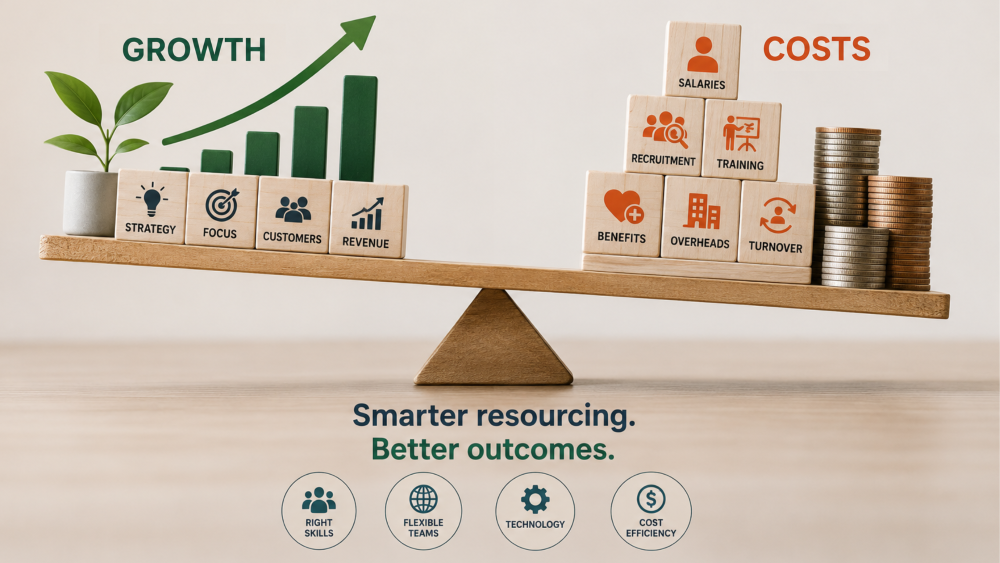

Growth is an exciting milestone for any agency, but it often brings a difficult question: how do you increase capacity without putting too much pressure on your margins?
Hiring has traditionally been the answer. More work means more people. But in today’s market, rising salaries, recruitment costs and ongoing employee expenses mean adding full-time staff isn’t always the smartest—or most sustainable—way to grow.
Recent survey results highlight just how significant this challenge has become. Thirty-eight per cent of agencies said HR costs have a very significant (26.2%) or an extremely significant (11.9%) impact on their decision to grow.
That statistic reflects a reality many agency owners know well. Winning a new business is one challenge. Building the team to deliver it profitably is another.
Effective resource planning can help agencies prepare for increased demand without taking on unnecessary long-term expenses.
The good news is that agencies have more options than ever before.
Growth doesn’t have to mean hiring locally
For many agencies, the default response to increased demand is to recruit another local full-time employee.
While that approach works in some situations, it also comes with considerable commitment. Recruitment fees, onboarding, leave entitlements, office costs and ongoing salary obligations all add up. If workloads fluctuate—as they often do in agency environments—that fixed cost can quickly become difficult to manage.
Instead of asking, “Who should we hire next?”, agencies are increasingly asking a different question:
“What’s the best mix of resources to support sustainable growth?”
This approach to resource planning encourages agency leaders to evaluate current workloads, future opportunities and the most appropriate talent model before committing to another permanent hire.
That shift in thinking opens the door to more flexible resourcing models that can grow alongside the business.
AI is changing how work gets done—but people still matter
Artificial intelligence has become an incredibly useful tool for agencies.
Content drafting, research, coding assistance, reporting, meeting summaries and administrative tasks can all be completed faster than they were just a few years ago. Agencies delivering custom development solutions can also use AI to streamline workflows while allowing experienced teams to focus on more complex technical requirements. Used well, AI can significantly improve productivity and reduce the time spent on repetitive work.
However, AI isn’t replacing experienced people.
Clients still rely on agencies for strategic thinking, creativity, problem-solving, and relationship management. These are all areas where human expertise remains essential.
Rather than replacing employees, AI allows agencies to make better use of their team’s time by removing some of the lower-value executional work.
That means agencies can often support more clients without increasing headcounts at the same rate.
For agency owners considering how to reduce business costs, AI can help lower the time and resources required for routine tasks while preserving human expertise for higher-value work.
Think beyond local full-time employees
The biggest opportunity for many agencies isn’t simply adopting AI—it’s expanding how they think about resourcing.
Today’s agencies have access to a much broader talent market than they did even five years ago. This flexibility also makes it easier to deliver additional web development services without immediately expanding local headcount.
Access to a broader talent pool can also improve business scalability by allowing agencies to expand their capabilities without building an unnecessarily large fixed-cost structure.
Depending on the work and the level of ongoing demand, different models can solve different problems.
Offshore full-time team members
For agencies with consistent workloads, offshore full-time employees can provide long-term capacity while keeping intellectual property, knowledge, and processes within the business.
These team members become embedded in the agency, working with the same systems, workflows, and culture as local staff. The result is a dedicated extension of the team that offers greater cost efficiency without sacrificing continuity or control.
Offshore freelancers
When workloads fluctuate or specialist skills are needed for short-term projects, freelancers can provide valuable flexibility.
Rather than carrying permanent overheads, agencies can scale resources up or down as client demand changes.
This approach is particularly useful for project-based work or specialist capabilities that are required every week.
White-label delivery partners
Another option is partnering with dedicated offshore white-label agencies.
Unlike individual freelancers, established delivery partners offer structured teams, proven processes, and the ability to support multiple service areas. This allows agencies to access experienced specialists without investing in recruitment, management, and operational infrastructure.
For agencies experiencing rapid growth, this can provide the flexibility to take on larger projects while maintaining quality and delivery standards.
White-label partnerships can strengthen business scalability by giving agencies access to additional capacity whenever it is needed, without requiring them to maintain that capacity permanently.
Build a blended resourcing model
The most resilient agencies rarely rely on just one approach.
Instead, they build a blended model that combines:
- Local team members focused on client relationships, strategy, and leadership.
- AI tools that improve efficiency and automate routine work.
- Offshore full-time employees providing dedicated delivery capacity.
- Freelancers for specialist or short-term expertise.
- White-label partners who offer scalable support during periods of growth.
Each resource plays a different role, creating a business that’s both flexible and resilient.
Strong resource planning ensures each task is assigned to the most suitable person, partner or technology based on its complexity, value and required level of expertise.
Rather than viewing these models as alternatives, they’re increasingly becoming complementary parts of a modern agency structure.
Growth should improve profitability—not reduce it
One of the biggest risks agencies faces is winning more work while reducing profitability.
If every new client requires another expensive local hire, growth can quickly become stressful rather than rewarding.
A smarter resourcing strategy helps avoid traps.
By matching the right type of resource to the right type of work, agencies can increase delivery capacity while maintaining healthy margins and reducing operational risk. The same approach can also help agencies provide technical website maintenance more efficiently by allocating specialised resources where they add the most value. The same approach can also help agencies provide technical website maintenance more efficiently by allocating specialised resources where they add the most value.
For businesses exploring how to reduce business costs, matching resource expenses to actual client demand can be more sustainable than relying entirely on permanent overheads.
Just as importantly, they gain the confidence to pursue new opportunities without worrying that every piece of growth creates another fixed cost.
Final takeaway
The agencies best positioned for long-term growth won’t necessarily be the ones with the largest local teams.
They’ll be the ones that build flexible operating models capable of adapting as client demand changes.
AI is improving efficiency, but people remain at the centre of great agency work. The opportunity lies in thinking beyond traditional hiring and building a balanced mix of local expertise, offshore talent and trusted delivery partners.
When supported by thoughtful resource planning, this blended approach creates stronger business scalability while helping agencies protect profitability as they grow.
For agencies feeling the pressure of rising HR costs, that shift in thinking could be the difference between growth that stretches the business and growth that’s genuinely sustainable.
Related Articles
Why Choose Us?
With decades of experience and a dedicated team, we are committed to delivering high-quality web development services. Our client-centric approach ensures that we understand your needs and provide solutions that exceed your expectations.