


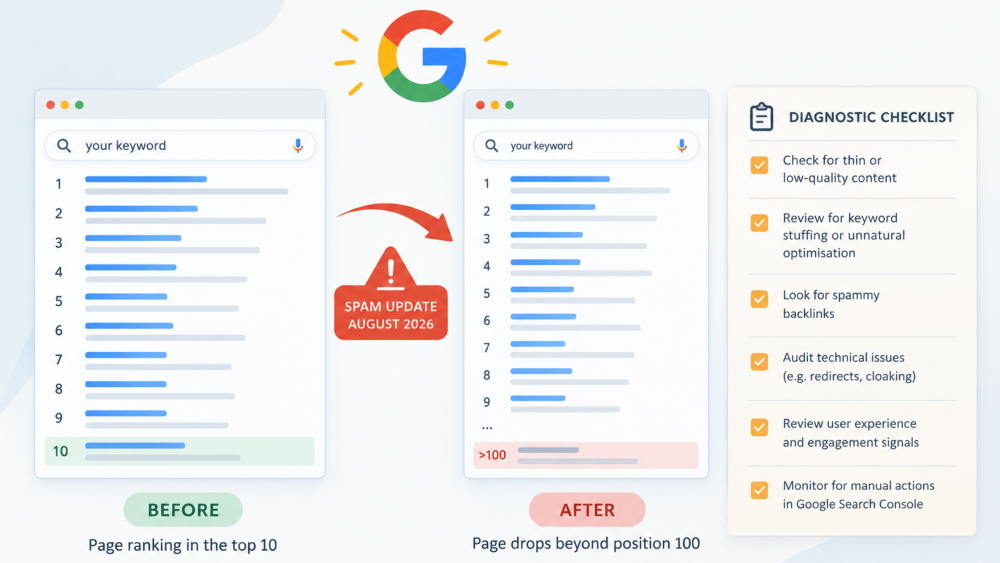

A top ranking is not a permanent position
SEO rankings can feel more stable than they really are.
A page might sit comfortably in position three for months, generating a steady stream of leads or sales. It is tempting to assume that strong historical performance means the page is effectively protected from future changes.
It isn’t.
Google’s ranking systems continually reassess which pages should appear for particular searches. A significant update can change the relative position of thousands of pages, meaning a previously successful URL can lose visibility even if nobody has manually taken action against the site.
The August data illustrates this particularly well. SE Ranking analysed 100,000 US keywords across 20 industries and found significant volatility across every industry it tracked. Top-10 volatility ranged from 74.64% in real estate to 85.55% in fashion and beauty.
There was movement in the other direction, too. SE Ranking reported a 12% increase in the percentage of URLs entering the top three after the update that had previously been outside the top 20.
In other words, this wasn’t simply a case of Google removing visibility. Search results were being reshuffled.
Algorithm volatility should trigger diagnosis, not panic.
Don’t immediately assume you’ve been penalised
One of the easiest mistakes after an algorithm update is to see traffic or rankings fall and conclude that Google has penalised the site.
That’s not necessarily what has happened.
Google distinguishes between its automated ranking systems and manual actions. Its Search Essentials explain that spam policies cover behaviours that can result in pages or entire sites ranking lower or being omitted from Search, while manual actions can result from human review.
A ranking decline during an algorithm update therefore needs context.
Start by asking:
- Which pages lost visibility?
- Which keywords were affected?
- Did the losses occur across the site or in particular content areas?
- Were competitors affected as well?
- Did rankings fall temporarily and then begin to recover?
- Are there common characteristics among the pages that declined?
This page-level view is much more useful than looking only at total organic sessions. Implementing tailored website SEO solutions often starts with this exact diagnostic approach.
For example, a 20% drop in organic traffic might sound alarming. But if most of the decline comes from a small group of low-value pages while your core commercial pages remain stable, the appropriate response is very different from a situation where your highest-value landing pages have all lost visibility.
Look for patterns, not a single culprit
Once affected pages have been identified, the next step is to look for common characteristics.
Google’s current guidance encourages site owners to assess whether content is genuinely helpful, reliable and created for people rather than primarily to attract search traffic. It specifically recommends examining which pages were most affected by a ranking drop and what types of searches those pages were targeting.
That makes an update a useful opportunity for a broader content audit.
Look for issues such as:
Thin or low-value content
Does a page actually provide enough information to satisfy the searcher’s intent?
Pages that contain little original information or simply repeat what is already available elsewhere may struggle when Google’s systems reassess search quality.
Duplicate or substantially similar content
Large groups of pages targeting very similar searches can create a site that is broad but not particularly useful.
The question isn’t simply whether two pages contain some of the same words. It’s whether they each serve a distinct purpose for the user.
Aggressive SEO tactics
Review practices designed primarily to manipulate rankings rather than improve the user’s experience.
Google’s spam policies include practices such as cloaking, manipulative redirects and scaled content abuse. Google defines scaled content abuse as producing many pages primarily to manipulate rankings rather than help users, regardless of whether those pages are created manually, automatically or with generative AI.
Content created mainly for search engines
A useful test is simple: Would this page still be worth creating if Google did not exist?
Google’s guidance recommends creating content for an existing audience and prioritising original information, useful analysis, expertise and a satisfying experience rather than producing pages simply because a topic appears capable of attracting search traffic.
Don’t make major changes too quickly
A significant ranking drop creates understandable pressure to act.
But changing dozens of pages immediately can make diagnosis harder.
If rankings are still moving, consider giving the update time to settle before making large-scale changes. Document what happened first: record affected URLs, keywords, ranking positions, organic traffic and the timing of the decline.
Then make changes based on evidence.
This is particularly important because SEO recovery is rarely a quick technical fix. If an update has changed how Google’s systems assess a site’s content or spam signals, improving the underlying quality may take time to be reflected in search results.
That doesn’t mean doing nothing. It means making deliberate improvements rather than changing titles, content, internal links and URLs all at once and then being unable to determine what actually helped.
Review the whole SEO picture
Another common mistake is to blame one factor.
A ranking decline isn’t automatically a content problem, just as it isn’t automatically a backlink problem or a technical SEO problem.
A sensible review should consider several areas together:
- Content: Is it original, useful, accurate and aligned with search intent? As search shifts toward AI-powered search, information richness matters more than ever.
- Technical SEO: Can Google access, crawl and index the important pages?
- Internal linking: Are important pages clearly connected and discoverable?
- Backlinks: Does the site’s link profile contain obvious quality or manipulation concerns?
- Site structure: Are there unnecessary, duplicated or low-value pages?
- User experience: Does the page actually deliver what the search result promises?
- Search intent: Has the page remained the best answer for the query?
Google’s Search Essentials emphasise that meeting technical requirements alone does not guarantee that content will be crawled, indexed or served. The broader goal is to create helpful, reliable, people-first content while avoiding practices covered by its spam policies.
What to do after a major spam update
For businesses and agencies managing organic search optimisation, a practical response can be relatively straightforward.
- Establish the timeline.
Confirm when rankings and traffic changed and compare the movement with the official update window. - Analyse at URL and keyword level.
Don’t rely solely on site-wide traffic or average ranking positions. - Segment affected pages.
Look for common content types, templates, topics or SEO practices among pages that lost visibility. - Compare winners and losers.
The pages replacing your rankings can provide useful clues about what Google is currently rewarding for those searches. - Audit quality and spam risks.
Review content, duplication, scaled production, redirects, technical issues and other potential problems against Google’s current guidance. - Prioritise meaningful improvements.
Improve pages because they are genuinely more useful to people, not simply because you want to add more keywords and manipulate search engine optimisation results. - Monitor before and after.
Keep a record of changes and watch rankings over time rather than expecting an immediate recovery.
The bigger lesson from August
The August 2026 spam update is a useful reminder that SEO performance is never completely static.
A page can rank well today and lose substantial visibility tomorrow when Google’s systems reassess search quality. The fact that top-10 URLs were 82% more likely to fall beyond the top 100 during this update than during the comparison period demonstrates how disruptive a major algorithm change can be.
But the right response isn’t panic.
A ranking drop is a signal to investigate. Look at the pages and queries affected, identify patterns, assess the quality and purpose of the content, review technical and SEO factors together, and allow enough time to distinguish temporary volatility from a sustained change.
The strongest long-term response is still the simplest one: create useful, original, well-supported content that satisfies the user’s intent and avoid tactics designed primarily to manipulate search rankings. Back this up with reliable site maintenance solutions to preserve technical health.
When Google changes the rules, the best first move isn’t to react. It’s to understand what changed.
Related Articles




Why Choose Us?
With decades of experience and a dedicated team, we are committed to delivering high-quality web development services. Our client-centric approach ensures that we understand your needs and provide solutions that exceed your expectations.