


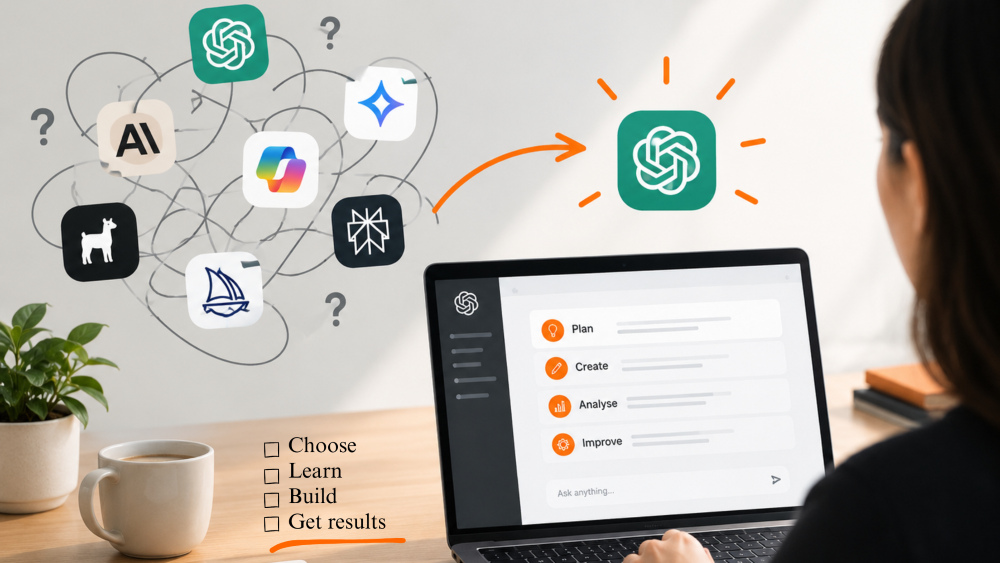

There has never been more choice when it comes to AI.
ChatGPT, Claude, Gemini, Copilot, Perplexity and a growing list of coding agents are all competing for a place in your daily workflow. Every week brings another benchmark, product launch or social media post explaining why one of them is now the clear winner.
For agency owners, that creates a surprisingly difficult question: which AI tool should we actually use?
If you’re wondering how to choose the right ai tool, the answer starts with understanding your team’s actual needs rather than chasing whichever platform is generating the most attention this week.
The temptation is to keep testing. Try Claude this week. Move to ChatGPT next month. Add Gemini because someone says it handles research better. Then throw a coding agent into the mix because your developer says it has just become dramatically better.
There is a better approach.
Pick a tool that fits your business, then invest in learning how to use it well.
The specific tool matters. But over time, your familiarity with the tool, your workflows and the context you have built around it can matter just as much.
The AI leaderboard keeps changing
The first problem with trying to identify the “best” AI tool is that the answer doesn’t stay still for very long.
Over the past 12 months, we’ve seen major improvements from both Anthropic and OpenAI, particularly in coding and agentic tools.
Claude Code has developed into a serious development environment rather than simply a chatbot that writes code. Anthropic’s research, based on analysis of around 400,000 Claude Code sessions, found that users typically make the planning decisions while Claude handles much of the execution.
OpenAI has been pushing in a similar direction with Codex. Its latest generation is designed to handle longer-running development tasks, use tools and work across complex projects. OpenAI has also expanded Codex into multi-agent workflows, where several agents can work on different tasks in parallel.
That means yesterday’s recommendation can become today’s outdated advice surprisingly quickly.
And that’s important for anyone trying to make a technology decision based on social media.
You are rarely seeing a permanent ranking. You are seeing a snapshot.
The real question isn’t “Which AI is best?”
A better question is:
Which AI tool is best for the way we work?
An agency heavily invested in Microsoft may naturally gravitate towards Copilot. A team that lives in Google Workspace may find Gemini particularly useful. A developer working extensively in the terminal may care far more about Claude Code or Codex than the quality of a consumer chatbot.
And someone primarily using AI for research, writing and analysis may have completely different priorities.
There isn’t necessarily one winner across all of those situations.
This is why an ai tool comparison should focus on your team’s real workflows, integrations and requirements rather than relying solely on public benchmarks.
Even the broader developer market reflects this. Stack Overflow’s 2025 Developer Survey found that 84% of respondents were using or planning to use AI tools in their development process, while 51% of professional developers were using them daily. OpenAI’s GPT models had been used by 82% of developers for development work, while Claude Sonnet was used by 45% of professional developers.
The important point is not that one number proves one model is better.
It is that the market is already large, competitive and fragmented.
You don’t need to participate in every part of it.
Switching tools has a hidden cost
The monthly subscription is the obvious cost of an AI tool.
The less obvious cost is everything you build around it.
Once an agency has used an AI assistant for months, people develop habits. They learn how to structure prompts. They learn what context the model needs. They discover which tasks it handles particularly well and which require more supervision.
They create reusable prompts, project instructions, templates and workflows.
Developers also become familiar with how an AI coding agent behaves inside their repositories: how they structure requests, review changes, run tests and manage permissions.
For more complex projects, teams may also need custom web development services alongside AI-assisted workflows, particularly when existing systems require specialised implementation.
None of that appears on the software subscription invoice.
So when you switch tools, you aren’t simply cancelling one subscription and starting another.
You are potentially resetting part of that accumulated knowledge.
There can also be a surprisingly practical cost. Different tools have different interfaces, integrations, configuration options, context management and ways of working. Teams have to learn them. Existing processes may need to be rebuilt.
That same principle applies to your website infrastructure, where ongoing website support can help keep established systems reliable as your business and technology stack evolve.
If you have three people spending several hours evaluating and configuring a new tool, the “cheap” experiment may already have cost more than the monthly subscription you were trying to optimise.
For many agencies researching the best ai tools for business, the real cost calculation should include training time, workflow changes and the effort required to rebuild processes, not just the monthly licence fee.
Consistency can be more valuable than marginal capability
This doesn’t mean you should never change.
If a tool genuinely isn’t working for your business, move.
If your requirements change, reassess.
If a new product offers a significant improvement in an area that matters to your business, test it properly.
But there is a difference between strategic evaluation and constantly chasing the latest model.
One approach asks:
Does this tool materially improve an important part of our workflow?
The other asks:
Is this week’s model slightly better than the one we’re currently using?
The first question is useful.
The second can become a distraction.
Over the last six months, conversations with agency owners have reinforced this. Claude, particularly Claude Code, has been a common choice among agencies doing substantial development work. At the same time, OpenAI’s rapid progress with Codex has made the decision considerably less straightforward.
That is exactly the point.
The tools are competing so aggressively that there is likely to be continual movement at the top.
Learn the workflow, not just the model
The biggest opportunity is to stop thinking about AI as a collection of clever prompts and start thinking about it as part of your operating process.
For an agency, that could mean deciding:
- Which AI tool is the default for the team?
- Which tasks should it be used for?
- What information should always be provided as context?
- What work requires human review?
- What should never be delegated to an AI agent?
- Which prompts, instructions and workflows should be standardised?
- How should AI-generated work be checked before it reaches a client?
This is where familiarity starts to compound.
The value isn’t simply that someone knows how to ask ChatGPT a good question.
It’s that the team has developed a reliable process for turning AI into useful work.
That might be drafting a project brief, analysing a large document, researching a technical issue, writing code, reviewing a pull request or preparing a first version of a client deliverable.
For marketing teams, the same approach can extend to search engine optimisation, where AI can support research and content workflows while human review remains essential.
The more repeatable the process becomes, the less important it is whether this month’s model scores one or two points higher on a benchmark.
Don’t confuse experimentation with productivity
There is also a broader lesson for agency leaders.
AI tools are evolving rapidly enough that experimentation is sensible. But experimentation needs a purpose.
A simple quarterly review can be enough.
Pick the tool or tools your team relies on. Identify the five or ten workflows where AI provides the most value. Then test alternatives against those actual workflows rather than generic online benchmarks.
For example:
Current tool: Claude Code
Alternative: Codexf
Test: Can each complete the same real-world development task to the required standard?
Measure the things that actually matter:
- Time saved
- Quality of the output
- Amount of human correction required
- Reliability
- Ease of use
- Cost
- Security and governance
- Fit with existing systems
Then make a decision.
If the alternative is materially better, switch.
If it isn’t, get back to work.
Running this kind of practical ai tool comparison gives an agency a clearer basis for change than repeatedly switching because of a new benchmark or viral recommendation.
The best AI tool may simply be the one you know best
The AI market is going to continue changing.
Claude will improve. OpenAI will release new models. Google will keep developing Gemini. Other companies will appear with specialised tools that perform exceptionally well in particular areas.
There will always be another comparison video, another benchmark and another person on LinkedIn declaring that they have found the new winner.
That’s fine.
For an agency owner, the goal isn’t to win the AI leaderboard.
It’s to use AI to help the business deliver better work, more efficiently and reliably.
Pick a strong tool. Build it into your workflows. Teach your team how to use it properly. Then reassess periodically rather than constantly.
If you’re still working out how to choose the right ai tool, start with the tasks that matter most to your business and evaluate tools against those tasks—not against someone else’s workflow.
The models will keep changing.
Your ability to get useful work out of them is the asset worth building.
Related Articles
Why Choose Us?
With decades of experience and a dedicated team, we are committed to delivering high-quality web development services. Our client-centric approach ensures that we understand your needs and provide solutions that exceed your expectations.