


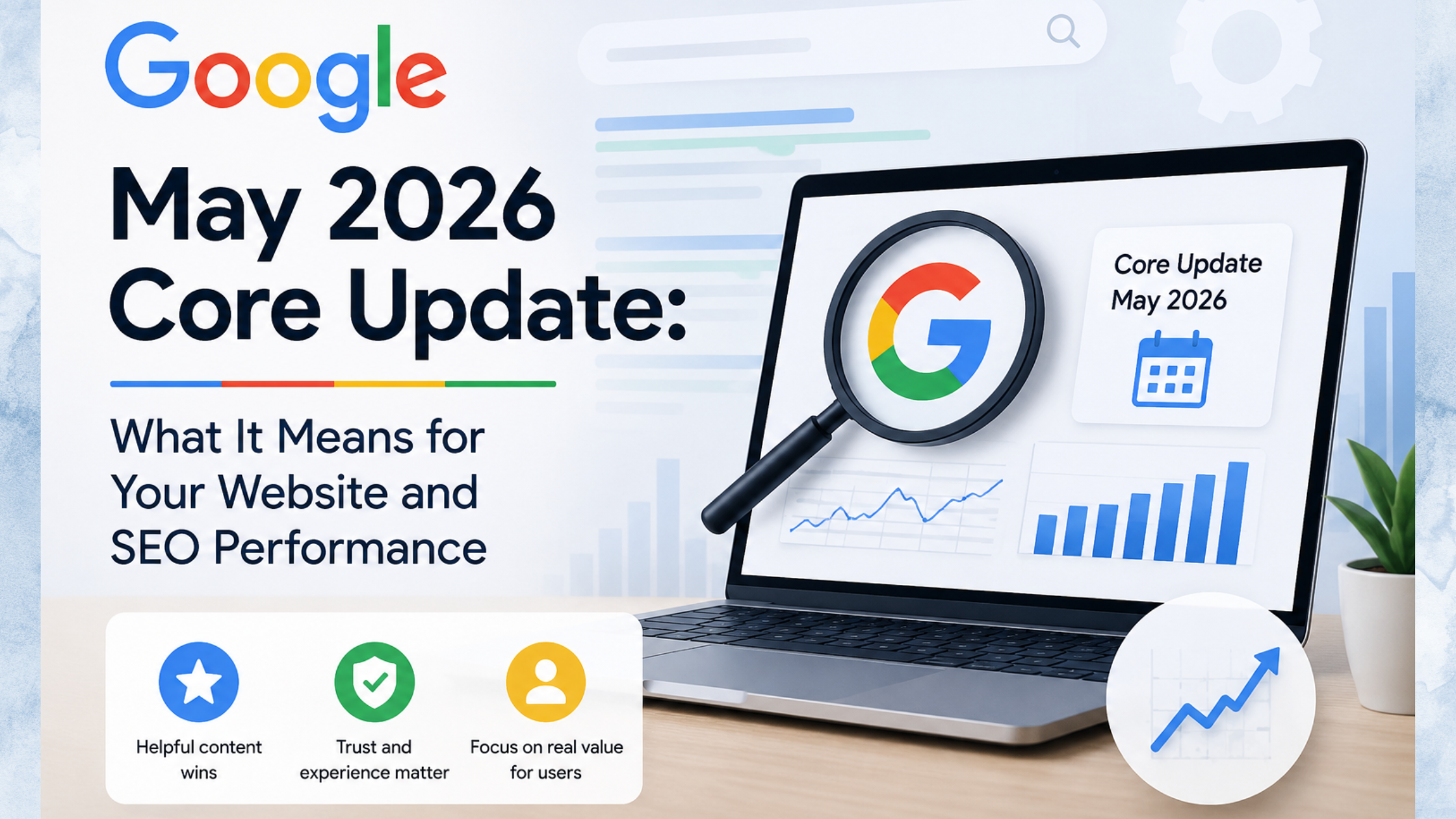

Google has officially began rolling out its May 2026 Core Update, the second broad core update of the year.
For many businesses, announcements like this immediately raise concerns about rankings, traffic, and lead generation. It’s common to see website owners refreshing Search Console, monitoring ranking tools, and trying to determine whether their site has been affected, particularly for professional business websites.
While core updates can have a significant impact on organic performance, it’s important to understand what they are—and what they aren’t.
A drop in traffic doesn’t automatically mean something is broken. In many cases, Google is simply reassessing which pages are the most helpful, relevant, and useful for users compared to competing content. The rollout began on 21 May 2026 and is expected to take up to two weeks to complete. Google has described it as a regular core update designed to better surface relevant and satisfying content for searchers.
The most important thing website owners can do right now is avoid panic and focus on long-term strategies to improve search rankings rather than short-term reactions.
What Is a Google Core Update?
Core updates are broad changes to Google’s ranking systems.
Unlike spam updates, which often target specific behaviours or policy violations, core updates affect how Google evaluates content across the web. The goal is to improve search results by surfacing pages that better satisfy user intent and provide a stronger overall experience.
Google regularly releases core updates throughout the year. They are a normal part of how the search engine evolves and adapts to changing user expectations.
Importantly, a core update is not a penalty.
If a page loses rankings, it doesn’t necessarily mean Google has identified a problem with the website. Instead, Google may have found other pages that it believes better answer the user’s query.
This distinction is critical because it changes how businesses should respond.
Why Organic Search Rankings and Traffic Can Change
One of the biggest misconceptions around core updates is that ranking drops indicate a technical issue.
In reality, rankings often change because Google’s understanding of content quality, relevance, and usefulness has shifted.
A website may lose visibility because:
- Competitors have published more comprehensive content
- Search intent has evolved
- Information on the page has become outdated
- The content no longer fully answers user questions
- Other pages provide a better overall user experience
At the same time, websites that have invested in genuinely helpful content may see gains.
Google has consistently stated that its goal is to reward content that is useful, trustworthy, and focused on helping people rather than simply targeting search engines.
That means rankings can move even when no changes have been made to the website itself.
Why You Shouldn’t Make Immediate Changes
One of the most common mistakes businesses make during a core update rollout is reacting too quickly.
A website experiences a temporary drop in rankings, and suddenly there is pressure to rewrite pages, change site structure, remove content, or launch major SEO initiatives.
The problem is that rankings often fluctuate throughout the rollout period.
Google itself advises website owners to wait until the update has fully completed before drawing conclusions from performance data. Early ranking movements rarely tell the full story.
Making significant changes during the rollout can create additional variables that make it harder to understand what actually happened.
Instead, the better approach is to:
- Monitor rankings and traffic
- Record key performance benchmarks
- Avoid drastic site changes
- Wait for the rollout to finish
- Review performance trends once results stabilise
Patience often leads to better decisions.
What to Review After the Update
Once the rollout has been completed and rankings have settled, it’s time to analyse the impact.
Rather than focusing on individual keyword fluctuations, look for broader patterns.
Questions worth asking include:
Which Pages Lost Visibility?
Review landing pages that experienced the largest drops in traffic.
Look for common themes:
- Are the pages outdated?
- Do they still align with current search intent?
- Are competitors providing more detailed information?
Which Keywords Changed Most?
Keyword-level analysis can help identify shifts in how Google is interpreting search intent.
Sometimes rankings fall because Google now believes users want different types of content for that query.
What Are Competitors Doing Better?
Search results are relative.
A ranking decline may have less to do with your content and more to do with improvements made by competing websites.
Compare:
- Content depth
- User experience
- Content freshness
- Expertise and credibility signals
- Internal linking structures
This often reveals opportunities for improvement.
The Areas Worth Improving
When a core update affects performance, the solution is rarely a quick technical fix.
Instead, improvements usually focus on creating a better experience for users.
Some of the most effective areas to review include:
Content Quality
Ask whether the page genuinely helps users achieve their goal.
Can information be expanded, clarified, or updated?
Would a visitor leave the page with their questions answered?
Search Intent Alignment
Search intent remains one of the strongest drivers of rankings.
If users are looking for practical advice but the page focuses on promotion, there is likely a mismatch.
Understanding what users expect to find is often more important than simply targeting keywords.
Content Freshness
Outdated information can reduce the value of otherwise strong content.
Regular updates help ensure pages remain accurate and relevant.
Internal Linking
Strong internal linking helps both users and search engines understand relationships between content.
It can also improve content discoverability and topical authority.
User Experience
A page can contain excellent information but still struggle if the experience is poor.
Factors such as readability, page structure, navigation, and mobile usability all contribute to overall usefulness.
Focus on Long-Term SEO Success
Core updates can create short-term uncertainty, but they also provide valuable feedback.
They encourage businesses to focus on the things that matter most:
- Helpful content
- Strong user experiences
- Accurate information
- Clear expertise
- Genuine value for visitors
These are the same principles that support sustainable SEO growth regardless of how Google’s algorithms evolve.
The websites that perform best over time are typically those that focus on serving users first and search engines second.
The Takeaway
Google’s May 2026 Core Update is another reminder that Search Engine Optimisation is not a set-and-forget activity.
Changes in rankings and traffic are a normal part of search, particularly during broad core updates. A drop in visibility doesn’t automatically mean something is wrong with your website, nor does it mean drastic action is required.
The best approach is to stay calm, let the rollout complete, and analyse the results carefully.
Once the data settles, focus on improving content quality, matching search intent, updating outdated information, strengthening internal links, and making pages genuinely more useful for users.
In the long run, the websites that consistently help people are the ones Google wants to reward.
Related Articles



Why Choose Us?
With decades of experience and a dedicated team, we are committed to delivering high-quality web development services. Our client-centric approach ensures that we understand your needs and provide solutions that exceed your expectations.