


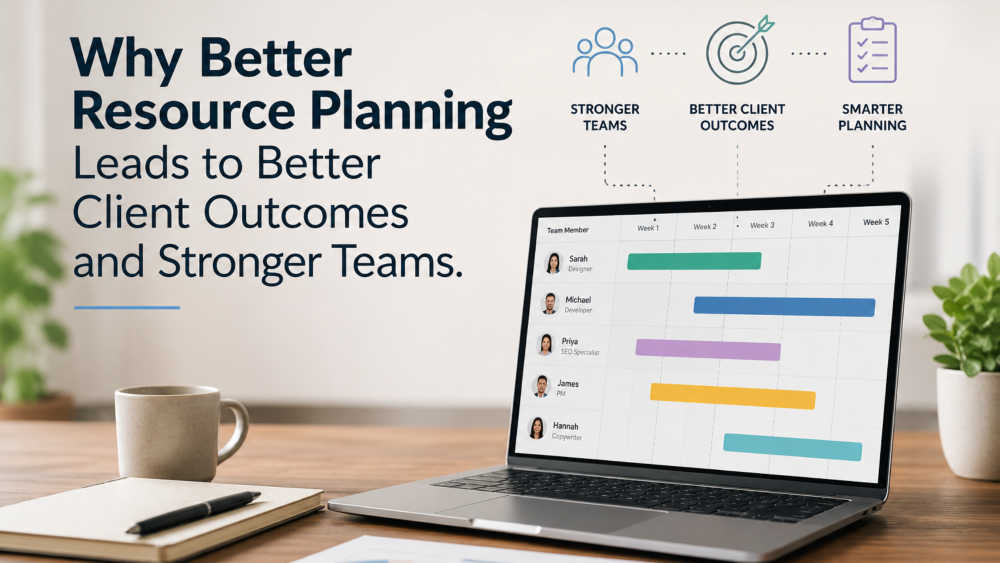

In agency environments, urgent requests are a normal part of the job.
A client needs a critical website fix before a campaign launch. A stakeholder suddenly requests a feature change. A priority shifts overnight, and the team is expected to respond immediately.
For agencies delivering custom web development services and ongoing digital projects, these unexpected requests are often a standard part of managing complex client requirements.
The challenge is that most development and delivery teams are already operating close to capacity. When unexpected work arrives, agencies often face a difficult choice: delay existing commitments or squeeze more work into an already full schedule.
Without strong resource planning, this situation quickly becomes reactive. Teams rush to accommodate new requests, project timelines become unstable, and stress levels increase across the business.
Good resource management helps agencies avoid this cycle. It creates visibility, supports better decision-making, and allows teams to deliver high-quality work without relying on last-minute heroics.
The Reality of Limited Resources
Every agency wants to be responsive to its clients.
The problem is that responsiveness is often confused with immediate action.
In reality, every urgent request competes with work that has already been planned, estimated, and scheduled. Development teams cannot simply absorb additional work without consequences elsewhere.
This is particularly challenging because urgency is often subjective.
From a client’s perspective, their request may feel critical because it affects their business directly. From a delivery perspective, that same request needs to be assessed against existing commitments, project deadlines, available resources, and technical complexity.
When every task is labelled “urgent” or “ASAP”, teams lose the ability to prioritise effectively.
Instead of focusing on the highest-impact work, delivery teams spend their time constantly switching between competing priorities. This context switching reduces efficiency and increases the risk of mistakes.
The reality is that agency resources are finite. Successful delivery depends on understanding capacity and making deliberate decisions about where time and effort should be allocated.
The Cost of Poor Resource Management
When resource planning is weak, agencies often default to reactive decision-making.
An urgent request arrives, and the immediate response is to find someone available to work on it. The long-term impact is rarely considered until problems begin to surface.
This approach creates several issues:
- Work is rushed to meet unrealistic expectations.
- Existing projects lose momentum.
- Deadlines begin to slip.
- Quality assurance processes are compressed or skipped.
- Teams experience higher levels of stress.
The impact on employees is significant. Research from Eagle Hill Consulting found that 45% of workers report experiencing burnout, with workload remaining the leading cause. The same study identified staff shortages and increasing demands as major contributing factors.
Similarly, Gallup research found that 76% of employees experience burnout at least sometimes, with unmanageable workloads and unclear communication among the key drivers.
For agencies, burnout isn’t just a people issue. It directly affects delivery performance.
Overloaded teams are more likely to make mistakes, miss deadlines, and struggle to maintain the level of quality that clients expect.
The result is often a cycle where poor planning creates delivery issues, delivery issues create client pressure, and client pressure creates even more reactive work.
Managing Client Expectations Effectively
One of the most overlooked aspects of resource management is communication.
Clients generally understand that priorities need to be balanced. Problems usually arise when expectations are set incorrectly.
When an urgent request comes in, the goal shouldn’t be to immediately promise delivery. The first step should be assessing the scope, complexity, and impact of the request.
Only then can a realistic timeline be provided.
This doesn’t mean saying no to clients. It means giving them accurate information so they can make informed decisions.
For example, instead of responding with:
“We’ll try to get this done today.”
A more effective response might be:
“We’ve reviewed the request and assessed the team’s current workload. We can prioritise this task and have it completed by Thursday without affecting existing project milestones.”
The difference is subtle but important.
The second response demonstrates that the request has been taken seriously while also setting a realistic expectation.
Clients often become frustrated not because work takes time, but because expectations were poorly managed from the start.
Clear communication builds trust. Unrealistic promises erode it.
Proactive Planning Prevents Firefighting
The most effective agencies don’t wait for problems to appear before managing resources.
They create visibility across projects, workloads, and upcoming priorities.
This starts with regular planning sessions that review:
- Current project commitments
- Upcoming deadlines
- Resource availability
- Potential risks or bottlenecks
- New client requests
When teams can see future workloads, they can identify pressure points before they become delivery problems.
This visibility is especially valuable when managing additional web development services that arise during active project phases and require careful prioritisation.
A feature request due next month may seem manageable today, but if several major projects are scheduled to overlap during the same period, adjustments can be made early.
This proactive approach allows agencies to prioritise high-impact work before deadlines become critical.
It also creates more flexibility when genuinely urgent requests arise.
With stronger forecasting processes, agencies are better positioned to deliver scalable development solutions without compromising existing commitments or delivery quality.
If resource allocation is visible and regularly reviewed, teams can make informed trade-offs instead of scrambling for solutions under pressure.
Effective resource forecasting is not about predicting every scenario perfectly.
It’s about reducing surprises and giving teams enough visibility to make better decisions.
Building a More Sustainable Delivery Process
Sustainable delivery requires balance.
Agencies need to remain responsive to clients while also protecting the team’s ability to produce quality work consistently.
That balance becomes much easier when resource management is treated as an ongoing discipline rather than an administrative task.
Strong resource planning delivers benefits across the organisation:
For Clients
- More accurate timelines
- Better communication
- Higher-quality outcomes
- Greater confidence in delivery commitments
For Project Managers
- Better visibility over workloads
- Improved prioritisation
- Fewer last-minute escalations
- More predictable project delivery
For Developers and Delivery Teams
- Reduced context switching
- Lower stress levels
- Better focus on meaningful work
- More sustainable workloads
Most importantly, good planning creates an environment where urgent work can still be accommodated without disrupting everything else.
Not every urgent request requires panic.
In many cases, the best outcome comes from stepping back, assessing the work properly, and communicating a realistic path forward.
The Takeaway
Resource management is often viewed as a scheduling exercise, but its impact reaches much further.
When agencies proactively manage capacity, forecast workloads, and communicate clearly with clients, they create a delivery process that is more predictable, sustainable, and effective.
Urgent requests will always happen.
The difference is whether teams are forced to react to them or prepared to handle them.
Successful delivery rarely comes from last-minute heroics. It comes from good planning, clear communication, and a realistic understanding of what teams can achieve.
Related Articles



Why Choose Us?
With decades of experience and a dedicated team, we are committed to delivering high-quality web development services. Our client-centric approach ensures that we understand your needs and provide solutions that exceed your expectations.