


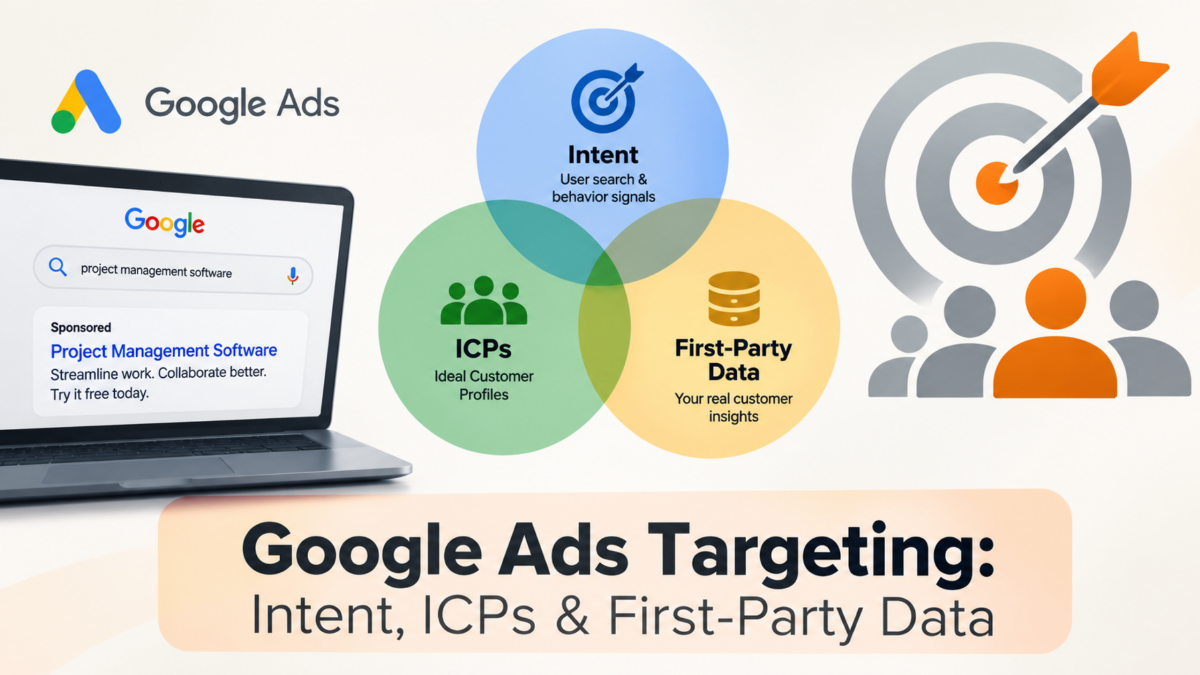

Your ideal customer profile isn’t a Google Ads targeting setting
A common expectation in B2B advertising is that you should be able to tell Google exactly who your ideal customer is.
For example: Target marketing managers at Australian companies with 50–200 employees.
That is a useful description of an Ideal Customer Profile (ICP). But it is not how Google Ads fundamentally identifies your best prospects.
Understanding how Google Ads targeting works means looking beyond static customer characteristics and focusing on the signals that indicate genuine buying intent.
Google Ads can use demographic and audience signals, but its strength is understanding what people are actively looking for and how likely they are to take a valuable action. Google itself describes audience targeting as reaching people based on who they are, their interests and habits, what they are researching and whether they have already interacted with a business.
That distinction matters.
Your ICP describes the type of customer you want. Intent helps identify when someone is behaving like a potential customer.
And increasingly, your own first-party data helps Google’s AI understand which of those people are actually valuable to your business.
Google and LinkedIn start from different signals
It is useful to compare Google Ads with LinkedIn because the platforms solve different targeting problems.
LinkedIn has access to professional information associated with its members. Its advertising platform supports targeting based on attributes such as job title, company, industry and seniority.
That makes LinkedIn particularly useful when your strategy begins with an identity-based definition:
“I want to reach people in this role, at this type of company.”
Google is different.
On Search, the user is actively expressing a need through their query. Someone searching for enterprise CRM implementation partner is demonstrating a very different signal from someone who simply has the job title “Sales Director”.
The Sales Director might be an excellent prospect. But they might not be looking for anything today.
The person making the search is telling you something about their current problem.
That is why intent can be a stronger buying signal than demographics alone.
It doesn’t mean identity is irrelevant. Google Ads offers demographic and audience targeting options, and advertisers can use first-party audience segments and other signals alongside search.
For businesses exploring B2B targeting Google Ads strategies, the key is to combine your understanding of the buyer with the intent signals Google can observe when that buyer is actively researching a solution.
The important point is that an ICP should not be confused with a single targeting setting.
Keywords are the starting point, not the whole strategy
This also explains why simply building a large keyword list is no longer enough.
Keywords help Google understand the searches you want to participate in. But the real question is what happens after someone searches.
The same understanding of search behaviour can also inform search engine optimisation, where content is aligned with the problems and information people actively search for.
Consider two people searching for related services:
Both may be relevant to the same campaign. But the second query potentially communicates a much more specific need.
Google’s Search terms insights now groups searches into intent-based categories, helping advertisers understand which types of demand are driving performance.
This creates a more useful optimisation loop:
Search behaviour → conversion → customer quality → better signals → better optimisation.
In other words, effective Google Ads targeting is less about finding a perfect audience definition upfront and more about helping the platform recognise the searches and behaviours that correlate with valuable outcomes.
The goal isn’t simply to get more people searching for your keywords to click an ad.
The goal is to help Google distinguish between a click that looks good in the platform and a prospect that is genuinely valuable to the business.
The experience after that click also matters, with website performance optimisation helping ensure potential customers can access and use the destination effectively.
This is where first-party data becomes important
Imagine a B2B campaign generating 100 leads.
From Google Ads’ perspective, those leads may initially look broadly similar. But your CRM might tell a very different story.
Perhaps:
- 60 never respond.
- 20 aren’t a good fit.
- 15 become qualified opportunities.
- 5 become customers.
If Google only receives a signal saying “lead submitted”, the platform has limited information about what makes the five customers different from the other 95 leads.
Your CRM knows.
That is the opportunity with first-party data.
Google defines first-party data as information shared directly with a business, including data from websites, apps, physical stores and offline conversion data.
By connecting meaningful conversion information back to Google Ads, advertisers can give its optimisation systems a much better signal about what success actually looks like.
Google’s Smart Bidding uses conversion data and contextual signals to optimise bids at auction time. Its documentation specifically recommends measuring conversion actions that are valuable to the business and feeding those signals into bidding.
That changes the role of first-party data.
It is no longer just something you keep in the CRM for reporting.
It becomes an optimisation asset.
Four pieces of the first-party data puzzle
For businesses running lead-generation campaigns, there are several important components to get right.
1. CRM integration
Your CRM should capture what happens after the initial enquiry.
A lead becoming an opportunity, a qualified opportunity becoming a customer, or a customer reaching a particular revenue threshold are all potentially more meaningful signals than a basic form submission.
The more accurately those stages are recorded, the more useful the downstream data becomes.
2. Enhanced Conversions
Enhanced Conversions uses hashed first-party customer information to improve conversion measurement and help Google’s AI-powered measurement and bidding systems.
For lead generation, Enhanced Conversions for Leads can use information such as email addresses alongside conversion data to improve attribution and bidding performance.
This is particularly relevant as privacy changes continue to make reliable measurement harder.
3. Customer Match
Customer Match allows advertisers to use customer information they have collected to reach those customers through Google Ads.
For businesses with a meaningful customer database, this can provide another way to connect known customer information with advertising activity.
4. Offline conversion data
Many B2B conversions don’t happen on the website.
A prospect might submit a form, speak to sales several times, receive a proposal and eventually sign a contract weeks later.
Offline conversion imports help connect that later business outcome back to advertising activity. Google now recommends Enhanced Conversions for Leads as the upgraded approach to offline conversion imports, and from June 2026 Google is migrating offline conversion and Enhanced Conversions for Leads uploads towards Data Manager.
That matters because the conversion that matters to your business isn’t necessarily the conversion that happens on your website.
Stop optimising for the easiest number to measure
One of the most common mistakes in paid search is optimising around what the platform makes easiest to see.
Clicks are easy to count.
Form submissions are easy to count.
Qualified opportunities and revenue take more effort to connect.
But if you optimise for the wrong outcome, Google’s automation can become very good at delivering more of the wrong thing.
Google’s own guidance makes the principle clear: Smart Bidding works from conversion data, and better foundations of conversion data help the algorithms learn.
For a lead-generation business, that means the definition of “conversion” deserves serious attention.
A useful hierarchy might look like:
Click → enquiry → qualified lead → sales opportunity → customer → revenue
The further down that chain you can reliably feed meaningful data, the more closely advertising optimisation can align with the actual commercial objective.
So, what should your ICP do?
This doesn’t mean abandoning your ICP.
Quite the opposite.
Your ICP should shape the strategy, rather than being treated as a box you expect Google to tick for every impression.
Use your ICP to decide:
- Which problems and use cases you want to attract.
- Which customers are commercially valuable.
- Which searches indicate meaningful intent.
- Which leads should count as qualified.
- Which customer outcomes should influence optimisation.
- Which audiences and customer lists are worth testing.
Then use Google’s intent signals and your first-party data to help the platform find more of the behaviour associated with those outcomes.
Think of it this way:
Your ICP tells you what a good customer looks like. Intent tells you who may be in-market. First-party data helps Google learn which prospects actually turn into good customers.
The practical takeaway
Google Ads doesn’t need to perfectly identify your ideal customer before a campaign can work.
What it needs is a strong foundation.
Build campaigns around genuine customer intent. Use your ICP to guide the problems, audiences and commercial priorities you’re looking for. Then make sure your measurement captures what happens beyond the initial click.
Connect your CRM where possible. Implement Enhanced Conversions. Use Customer Match where appropriate. Feed qualified and offline outcomes back into Google Ads.
Most importantly, stop treating first-party data as something that only belongs in a reporting dashboard.
In an increasingly AI-driven advertising environment, the quality of the data you give the platform can influence the quality of the decisions it makes.
Your ideal customer isn’t a targeting setting.
It’s an outcome your advertising system should learn to recognise.
If you’re still asking, “how does Google Ads targeting work?”, the simplest answer is this: your ICP defines the customer you want, intent identifies people actively looking for a solution, and first-party data helps Google learn which of those prospects are most valuable.
Related Articles
Why Choose Us?
With decades of experience and a dedicated team, we are committed to delivering high-quality web development services. Our client-centric approach ensures that we understand your needs and provide solutions that exceed your expectations.